This year sees the 80th anniversary of the start of the Spanish Civil War, a particularly cruel and barbaric war which involved the martyrdom of tens of thousands of Catholic clergy and lay persons, and the pillaging and destruction of thousands of Catholic churches, chapels, and shrines. We are reminded of the physical and spiritual suffering of today's persecuted Church, especially in the Middle East, Africa, Pakistan, India, Burma, China , and not forgetting the suffering of the faithful in the so-called free world, Europe, the Americas, Canada, Australia, who are threatened and intimidated by anti-God legislation and powerful secular forces intent on destroying Christianity. Since the time of Christ, the Christian Church has been persecuted and vilified, and will continue to be until the end of time.
'If the world hate you, know ye that it hath hated me before you. If
you had been of the world, the world would love its own: but because
you are not of the world, but I have chosen you out of the world,
therefore the world hateth you. Remember
my word that I said to you: The servant is not greater than his master.
If they have persecuted me, they will also persecute you: if they have
kept my word, they will keep yours also' (John 15 v18-20)
Christ before Pilate -Munkacsy (1881)
I must confess that I have always found the history of the
Spanish Civil War (1936- 1939) confusing, although less so after reading ‘The Last Crusade’ by Warren Carroll, published by
Christendom Press. This account of an extraordinarily complex and
ruthless war, superbly written by an eminent Catholic writer, provides a welcome and refreshing antidote to the
anti-Catholic bias adopted by so many contemporary historians. Carroll
defines ‘Crusade’ as a ‘war for the sake of the Cross, a war to protect
Christian people from persecution and death on account of their faith in
Jesus Christ’. The Spanish Civil War was certainly this. In 1936,
the first year of the war, in just six months a total of thirteen Bishops
and nearly seven thousand priests, seminarians, monks and nuns were
martyred by the enemies of the Church. It was the greatest clerical
blood-letting in so short a space of time since the persecutions of the
Church by the ancient Roman emperors. Tens of thousands of churches,
chapels, and shrines in Spain were pillaged or destroyed. In response,
faithful Spanish Catholics proclaimed a crusade against the anti-religious government and the militarist international communist and anarchic forces backing it. In turn the former, the 'Nationalists', received substantial military support from Germany and Italy, with history revealing that Germany, under Hitler, regarded the War as an ideal opportunity for executing and perfecting military manoeuvres, to be subsequently used in World War 2. Additionally, it was important for Germany's future expansionist plans that Communism was defeated in Spain, for if Spain succumbed, so inevitably would Portugal. Matters were complicated still further by internal divisions on both sides, leading to fierce in-fighting and factional atrocities. After three years, and initially against all the odds
the crusaders triumphed, and the Church and the Faith in Spain were
saved. By astute diplomacy General Franco ensured the basic 'neutrality' of Spain during most of World War 2, thus depriving Hitler of vital sea bases and virtual control of the Mediterranean. This book, in paperback format (232 pages), once started, is
hard to put down.

*******************
'In Franco's Spain' by Captain Francis McCullagh, is another book on the Spanish Civil War which I strongly recommend. Published in 1937, this book is effectively primary source material on those aspects of the war personally experienced by McCullagh, an Irish Catholic journalist and renowned and respected war correspondent. I have other excellent books by McCullagh, all of which were based on personal experiences, these include the early years of the Bolshevik Revolution in Russia, also the persecution and martyrdom of the Catholic people in Mexico by their anti-clerical and masonic government. In all his writings I have found McCullagh objective and outspokenly honest, which includes his obvious loyalty and devotion to the Catholic faith. 'In Franco's Spain', is written in a 'grainy' and anecdotal style which adds authenticity, and includes some remarkable photographs, some lent by the 'Universe' and 'Catholic Herald' of the day. Salamanca was chosen by General Franco as his G.H.Q. base.

Rescued from the Grave - Parish Priest of St Ana, having been buried alive by the Reds, was rescued by the Nationalists, and is here shown describing his terrible experiences to a sympathetic group of Spanish Legionaries. Photo taken by correspondent of 'Diario de Noticias' of Lisbon.
The Corpse of a Nun - 'Dug up by the Reds and placed against a wall to be scoffed at.'
At one time, the author had been offered a bed in a building attached to a convent. The author's impression when meeting the two nuns deputed to welcome him, had been 'of faces as innocent and serene as the faces of the two angels who came to Sodom at even. They had the pure eyes of little children. These young women know nothing of the iniquity of the world.'
McCullagh very soon changed his mind, having spoken to the resident Padre, who had this to say:-
'These nuns belong to an Order which looks after lunatic girls and women. There are fifteen hundred inmates, nearly all of them from off the streets in Madrid. You have n
o idea of what a vicious city Madrid was. Many of these unfortunate women were caught young, and deliberately trained up in every form of depravity. The human brain cannot support such a life for long: their brains gave way. The Reds treated these nuns badly at first, but in the end even they began to realize what noble work they were doing, so they allowed them to carry on as long as they did not wear their habits.They even spared the convent chapel, though they destroyed every church in the town.They also destroyed another convent, down near headquarters
, belong
ing to a different Religious Order, contemplatives I
think
, murdering the nuns. We dug up one of the c
orpses the other day while constructing a communications trench. It was by the habit she wore that we recogni
zed her as one of those nuns. Probably the naked corpse we found at the same time was also that of a nun . Many were taken into Madrid, and we don't know what has become of them. One went mad, and is confined in this house
.' .............
'Although these nuns here have probably never been outside Spain, they would not have been so shocked as you think by the terrible reality of Golgotha. They witness every day the state of utter degradation to which man is reduced by sin...... I know that they have seen their patients in the last stages of degradation, and that they have had to listen to unutterable things from women in whom mental disease has killed all will-power, all reticence, all self-respect, and all shame, while leaving the memory intact, and increasing tenfold the rapidity of the tongue. These nuns have heard more horrors in this quiet convent than a priest hears in the confessional of any seaport from Suez to Santa Cruz........... Probably that accounts for their perfect calm, in presence of the fire now raining down from Heaven on Madrid. They expected nothing less, any more than the two angels who came to Lot, expected less than fire and brimstone on Sodom. This war is only one more ill, and not the worst; the worst ills are hidden: there are more terrible things in peace than there are in battle, even in that peace which is marked by a brighter tone in the stock markets, and by quiet conditions in the foreign exchanges. Some people in England and America have started a crusade against war: why do they not start a crusade against sin, the cause of war? But let's say no more about it. In this world which looks so pleasant, there are, beneath the surface, horrors too awful for words.'

Captain The Rev. Father Mulrean, Chaplain of the Irish Brigade, which numbered some 700 troops. The losses it sustained were relatively light, seven killed and about twenty wounded, with four of the dead shot accidentally by Spaniards who took them for Reds. Of the remaining fatalities, two were due to shells fired from a great distance, and one to a sniper, also afar off. The Irish never even saw the enemy, and in fact went home before the end of the war, as did many German and Italian troops. McCullagh complained that the Germans and Italians did something to help Franco, whereas the Irish did nothing. This was not deliberate or intended, rather a geographical and logistical accident, reflecting the chaotic and uncertain pattern of the war.
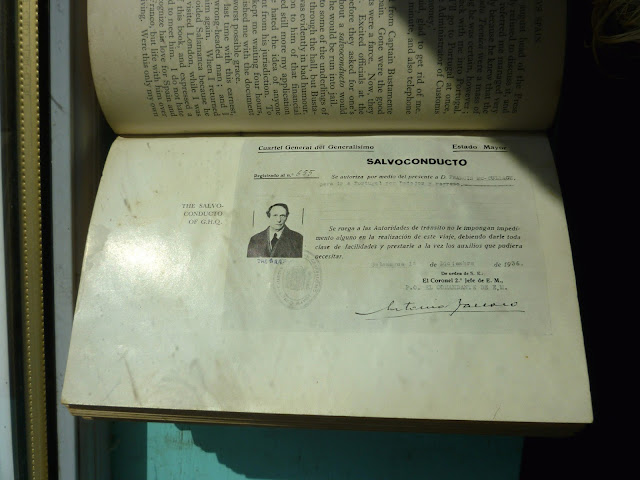
The 'Salvo-Conducto' of G.H.Q. - issued to the journalist Francis McCullagh prior to leaving Spain in 1937. Theoretically, this document guaranteed the holder re-admittance to Spain with a minimum of bureaucratic red-tape. In fact McCullagh did not return to Spain during the the war, not least because he suspected that he had been black-marked by the Spanish authorities who would likely refuse him entry anyway.
*********
'Holy Spain, set square at the extremity of Europe,
concentration of the Faith and the sun-baked Sierra,
invincible fort of the Virgin Mother,
Ultimate stride of Santiago the Apostle, stride which
ends only with the end of the world,
Land of Dominic and of John, of Francis the Conquerer
and of Teresa,
Arsenal of Salamanca, and pillar of Saragossa, and burning
root of Manresa,
Unconquerable Spain, where refusal and half-measures
have ever been unacceptable,
. . . . . . .
In this hour of thy crucifixion, holy Spain, in this day,
sister Spain, which is thy day,
My eyes filled with enthusiasm and tears, I send thee my admiration and my love!
Paul Claudel - French poet (1868-1955)
***************
(The item below is reproduced from a post written some eight years ago - my excuse is that it brings back very good memories! I have added a few photographs.)
Still with Spain in mind but
in a rather different context and on a personal basis, I have to admit that I have only visited Spain
once - about 17 years ago. At that time I was a member of the Exeter
Philharmonic Choir, about 100 strong, and we went to Spain to give two
concerts, one in Madrid at the Auditorio Nacional, and the other at
Salamanca in the Old Cathedral. Our Conductor and Master of Music was
Raymond Calcraft, who as a young man had attended the University of
Salamanca and who had been a lifelong friend of the world-famous Spanish
composer and musician Joaquin Rodrigo(1901-99). It was undoubtedly
through Raymond’s knowledge of all things Spanish and his contacts in
the Spanish musical world, that we had the pleasure and privilege of
performing in Spain. The first concert was in Madrid and was recorded
live on Spanish radio. What I particularly remember about the Auditorio
Nacional was the acoustics - or perhaps I should say, as far as it
appeared to me, the lack of acoustics. In England many of our concerts
were performed in Exeter Cathedral which is one of the largest and most
beautiful Gothic Cathedrals in Europe, with huge, high roofing-vaults
which echo and carry the human voice as ‘on the wings of a dove’. In the
Auditorio Nacional it was as though the walls were encased in
cotton-wool, you could not hear yourself singing and you could not hear
your colleagues, which I found quite off-putting.

Auditorio Nacional, Madrid
I remember that our
main programme comprised a Psalm set to music by Gustave Holst –
starting off very gently, and ending in a thunderous hymn of triumph ;
then followed a relatively short choral work, I think for women's voices
only, by Joaquin Rodrigo; and finally Dvorak’s 'Mass in D' for four voices
with Organ accompaniment. We were told later that the broadcast had
been well received, so clearly (forgive the pun!) my perception of the
acoustics was not reflected in the quality of the broadcast!
Our
second Concert was in the Old Cathedral in Salamanca. We travelled by
coach from Madrid to Salamanca and I remember thinking how bleak and
inhospitable much of the countryside appeared. I recollect small hamlets
just off the main road, apparently abandoned with no sign of life
except for the storks nesting in the roofs. Salamanca was different
altogether, with a wide river and green pastures, and a huge,
magnificent central square surrounded by ancient stone buildings and
small shops. Dominating the city are the two Catholic Cathedrals, the
Old Cathedral and the New, virtually side by side. The former is now
used primarily for artistic events such as concerts, and the latter is
the main place of worship.
New Cathedral, Salamanca
Our concert was in the evening in the
Old Cathedral, and when the time came I was amazed to see that the
building was absolutely packed, with people standing in the aisles and
right up to the front of the stage where the choir were. It seemed as if
the very walls of the Cathedral were bulging! I later discovered that
entry to the Concert was free and that it was traditional that all the locals
attended such events – which they certainly appeared to have done!
The
audience comprised people of all ages and walks of life, all of whom
showed genuine excitement and pleasurable anticipation. The extremely
close proximity of the audience - you could almost shake hands with
those in the front, and the attention, concentration, and appreciation
that they showed, was something never to be forgotten. We performed the
same programme as at Madrid, with everything going well up unto the
interval. Unfortunately when we returned to the platform some 15 minutes
later, we found that large numbers of the audience had disappeared! We
then learnt that many people had left because they thought that the
concert had come to an end, apparently not being familiar with the
concept of an 'interval'. Although I’m sure that programmes were
available, it may be that most of the audience did not avail themselves,
or it may have been that the interval was not clearly indicated.
Whatever the cause it was clear that drastic steps had to be taken. The
choir then retired for a second time from the platform, and search
parties were immediately dispatched to scour the neighbourhood in search
of the missing audience. Fortunately the extended interval allowed
many, if not most, to be traced and thus return in time for the much
delayed second half. Cynics might think that the mystery of the
vanishing audience was by design rather than accident, but I really
don’t think so. Prior to the start of the concert the audience
anticipation, interest and excitement, was palpable, and the
enthusiastic applause at the end of the first half was absolutely
genuine, as it also was at the end of the performance.
In spite of the
‘walk out’, I can honestly say that this particular concert is one that I
will always remember and treasure, for to have been privileged to sing
Dvorak's magnificent Mass in this historic and grand Old Cathedral,
enjoying an unusual intimacy and empathy with a highly appreciative and
receptive audience, was an unforgettable experience. A long time ago I know, but I wish to express my sincere gratitude to Raymond Calcraft for making this unforgettable experience possible. Over the years I have lost touch with him, but these memories do not fade. Thank you Raymond!
I would love
another opportunity to sing in the Old Cathedral. Realistically this is
probably unlikely, but I refuse to give up hope! Salamanca itself, with
its fine University and mediaeval buildings, its history and Catholic
culture, is a 'must' for visitors.
Old Cathedral, Salamanca - view of the nave (ack. anotherheader,wordpress.)
Prior to visiting Spain, a big
mistake on my part was the assumption that many, if not most Spanish
people speak English. In hindsight I realise that this was somewhat
arrogant, for why should Spanish people be expected to speak English?
Certainly in England you would not expect the natives to speak Spanish! I
suffered for this misapprehension on several occasions. Once in
particular, when after a tiring morning sight-seeing on my own in
Madrid, I decided that I needed something to eat. Surprisingly I had difficulty in finding a restaurant, and just as surprising, to me at least, was that nobody I approached for help spoke English. I eventually came
across a ‘McDonalds’ type establishment, and through the plate-glass
window I could see displayed on the walls, large coloured photographs of
particular meals on offer. I deduced that once in the restaurant, I
would be able to order a meal by the simple expedient of pointing at one
of these photographs, there would be no need to say a single word – and
so it transpired! Such was my first and last experience of eating-out
alone in Madrid. This was definitely not the most exotic place in which
to dine, but highly recommended for those who do not speak the ‘lingo’!
A
rather poignant memory is that of attending Holy Mass at 8a.m. on a
Sunday morning in Madrid and finding that there were perhaps 12 people
in total in the congregation. The church probably held 2/300 at least, a
lovely traditional Catholic church, and a devout young priest. This
perhaps is a reminder that the Church in Spain is still suffering from
the long-term effects of the Civil War, wounds since aggravated by the
liturgical and associated disasters since Vatican 2.
In 2001 Pope John Paul II beatified 233 of the martyrs of
the Civil War, and in 2007 Pope Benedict XVI beatified a further 498 –
the largest group beatification ever.
It is certain
that the blood of the holy Spanish martyrs will not have been shed in
vain.
‘Christus vincit,
Christus regnat, Christus imperat’.


