Friday, 15 May 2020

'Holy Mary, our most Blessed Queen and Mother'


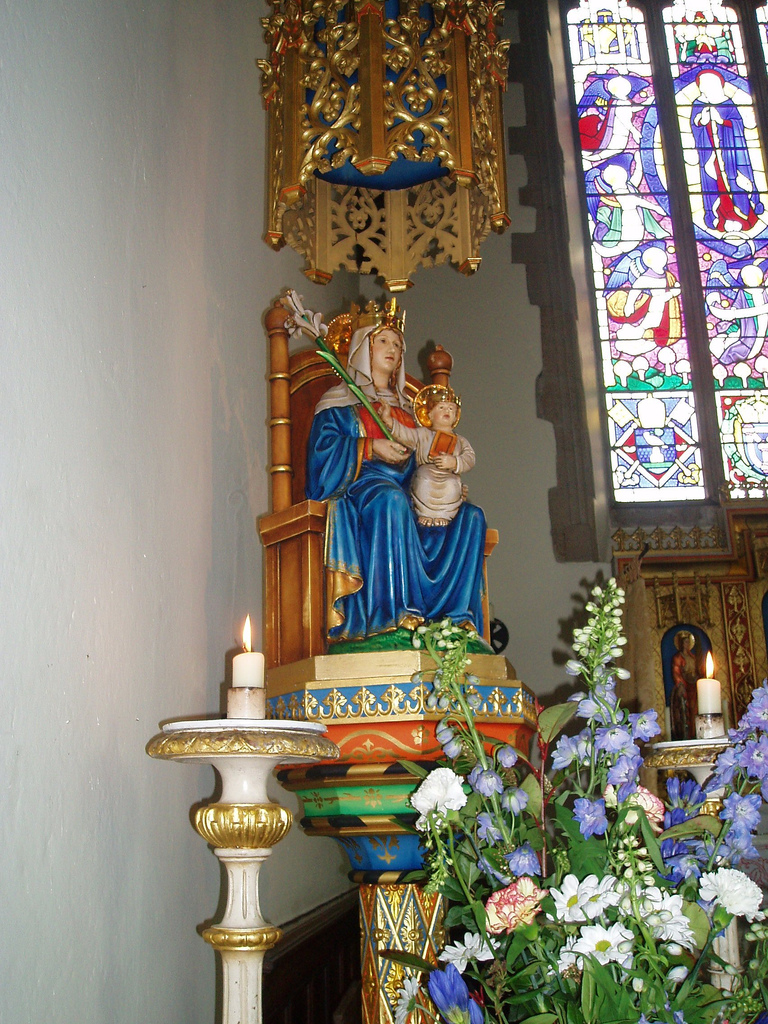
                                        'Our Lady of Walsingham'


Song to Our Lady

Medieval:  Author Unknown

Of one who is so fair and bright

Velut Maris Stella

Brighter than the day is light,

Parens et puella.

I cry to thee to turn to me:

Lady, pray thy Son for me,

Tam pia.

That I may come to thee,

Maria. 


In sorrow, counsel, thou art best,

Felix fecundate:

For all the weary thou art rest,

Mater honorata:

Beseech Him in thy mildest mood,

Who for us did shed His Blood

In Cruce,

That we may come to Him

In luce.


All this world was forlorn,

Eva peccatrice,

Till Our Saviour Lord was born

De te genetrice;

With thy Ave sin went away,

Dark night went and in came day

Salutis.

The well of healing sprang from thee,

Virtutis.


Lady, flower of everything,

Rosa sine spina,

Thou borest Jesus, Heaven’s King,

Gratia Divina.

Of all I say thou borest the prize,

Lady, Queen of Paradise

Electa:

Maiden mild, Mother

Es effecta.


 Well He knows He is thy Son,

Ventre quem portasti:

He will not refuse thy bone,

Parvum quem lactasti:

So courteous and so good He is,

He has brought us to our bliss

Superni.

Who hast shut up the dark foul pit

Inferni.


Bone, request.

The alternate Latin lines mean:

            As the star of the sea

            Mother and maid

            So loving

            Mary

            Happy and with offspring

            Honourable Mother

On the Cross

In light

From Eve a sinner

Of thee mother

Of salvation

Of virtue

Rose without a thorn

Grace Divine

Elect

Thou art become

Whom thou didst bear in the womb

Whom thou didst suckle as a baby

Of heaven

Of hell.

                                 Medieval: author unknown.         

                                    (ack.’The Mary Book’ – Sheed and Ward 1950)


                                             *******************


‘The May Magnificat’             by   Gerard Manley Hopkins


May is Mary’s month, and I

Muse at that and wonder why;

            Her feasts follow reason

            Dated due to season--------


Candlemas, Lady Day;

But the Lady Month, May,

            Why fasten that upon her,

            With a feasting in her honour?


Is it only its being brighter

Than the most are must delight her?

            Is it opportunest

            And flowers finds soonest?


Ask of her, the mighty mother:

Her reply puts this other

            Question:  What is Spring?

            Growth in every thing --------


Flesh and fleece, fur and feather,

Grass and greenworld all together;

            Star-eyed strawberry- breasted

            Throstle above her nested.


Cluster of bugle blue eggs thin

Forms and warms the life within:

            And bird and blossom swell

            In sod or sheath or shell.


All things rising, all things sizing

Mary sees, sympathising

            With that world of good,

            Nature’s motherhood.


Their magnifying of each its kind

With delight calls to mind

            How she did in her stored

            Magnify the Lord.


Well but there was more than this:

Spring’s universal bliss

            Much, had much to say

            To offering Mary May.


When drop-of-blood-and-foam-dapple

Bloom lights the orchard-apple

            And thicket and thorp are merry

            With silver-surfed cherry.


And azuring-over greybell makes

Wood banks and brakes wash wet like lakes

            And magic cuckoocall

            Caps, clears, and clinches all -----


This ecstasy all through mothering earth

Tells Mary her mirth till Christ’s  birth.

            To remember and exultation

            In God who was her salvation.

                                                                       Gerard Manley Hopkins

                                                         (ack. ‘The Mary Book’ Sheed and Ward  1950)


                                        *********************


File:Our lady of Walsingham I.jpg

'Our Lady of Walsingham'   (ack. Saracen 78 at Wikipedia)

                                           ***********

“But He, taking her by the hand, cried out, saying:  Maid, arise.

And her spirit returned,  and she arose immediately.  And He bid them  to give her to eat”  (Luke viii.  54/5)


A friend of Our Lord’s in Galilee

Had a dear little girl who died.

Her mother was sad, and her father was sad,

And everybody cried.


Our Lord was coming to make her well,

But she died before He came,

So they told Him not to bother,

But He bothered all the same.


He took the little girl’s hand in His,

And said:  “Little maid, arise!”

And the little girl came to life again,

Sat up, and opened her eyes!


Death must come to stay at last

And sorrow hard to bear,

But it doesn’t really matter,

So long as Our Lord is there.


            So we ask Our Lady

            To pray for us then

And come to us and bring her Son

At the hour of our death.

                                                Amen.”


    Taken from ‘The Hail Mary’  by  Margaret Hunt.

                 (Ack. The Mary Book  Sheed and Ward 1950.

Tuesday, 17 March 2020

'The Rosary' by Caryll Houselander - a prayer of love.


Many years ago I posted a copy of this beautiful poem on this blogsite. I have been wracking my brain to find a suitable subject as a post which is  sufficiently positive and affirmative to overcome the negativity and godlessness of our current 'coronavirus' media saturation. I have been drawn yet again to this lovely poem, overflowing with love of God, of humanity and God's Creation, instilling  peace and divine hope in our hearts


Frances Caryll Houselander
- mystic, poet, artist, writer
         (1901 - 1954)


The Rosary

In the doorway of a low grey house,
built of stones as old as the Crusades,
a woman of Bruges sits in the sunlight,
among the flowers, saying her Rosary.

She seems to be carved out of season walnut

and polished smooth
by the constant touch of the hand of God,
and the beads that twine her crippled fingers
are scarlet berries on the thorny twigs.

The running rhythm
and the repetition
of the Paters and the Aves
is like the rhythm that in nature
moves through the seasons
from seed to harvest
with the unity
and the pause and stress
of music;
like the bloodstream of Christ,
that flows through the seasons
from Advent to Easter
in the Liturgy of the Church,
the ebb and flow of the tide of love
in the Mystical Body of Christ.
             
II
God has given His children strings of beads,
as we give strings of beads to our children,
to teach them to count.

We do not say,
“Learn from these the doctrine of numbers,
the measure of human life,
the dream of Pythagorus,
counting the pulse of the world.”

We do not say
to a child with a string of beads,
“learn the perfection of reason in mathematics.”

We say,
“Learn to count on the beads,
small for your hands to hold,
bright for your eyes to see.”
And he begins,
slowly,
with one, two, three:
the spark is kindled
to light the flame of philosophy.

God has counted in fifteen Mysteries,
on the fingers of human creatures,
the singleness of the Undivided Love,
the simplicity
that we cannot comprehend
because our hearts are divided.
       
III
We are not all vessels of gold,
lifted up in virginal hands,
empty chalices to receive
from the perfect vine
love,
absolute
and complete.

But the old woman of Bruges
is a round bowl,
lifted up to be brimmed
with pure wine.
and the Mysteries of the Rosary
concern familiar things
known in her own life.

Her mind, like a velvet bee
droning over a rose,
gathers the honey of comfort
from the story of God,
familiar as the things in her kitchen –
the shining pots and pans,
the milk in the jar of earthenware,
and the flags of the scrubbed floor.

The story told by the Rosary
is the story of primitive beauty,
true as the burden of folk- songs.
It is a song piped on the hills,
by a shepherd calling his sheep.
     
IV
The cradle of wood,
the wood of the cross;
from cradle to cross,
like a lullaby;
the wail of an infant,
lost on the wind –
the arms of a girl
in a circle of love,
rocking to rest;
a woman’s arms
in a circle of love,
the young Man dead
on His Mother’s breast.

The jewels that glow
low in the grass
on the feet of Christ,
risen from death,
touching the flowers
and touching the dust,
even in glory.

The dust of the earth
on the feet of God,
walking the soft blue meadows of stars.
     
V
In the doorway of a low grey house,
built of stones as old as the Crusades,
a woman of Bruges
sits in the sunlight, among the flowers,
saying her Rosary.

The story of Mary is her own story,
and her son was her life’s joy
and her life’s sorrow;
and for ever
her son is her life’s glory.

In a field in Flanders,
among the red poppies, he is sleeping:
he will sleep soundly
until the day of resurrection.

She has still the patchwork quilt
made, when her hands were nimble,
for the wooden cot:
now he is sleeping, and each year
he has a new coverlet
of delicate young grass,
and at the end of his cot
a wooden cross.

The cradle of the wood,
the wood of the cross:
from cradle to cross,
like a lullaby.

The story of the woman of Bruges
is the world’s story.
it is the story
of human joy and sorrow,
woven and interlaced,
like the blue and crimson thread
in a woven cloth:
the story of birth and death,
of war and the rumours of war
and of peace past understanding,
peace in the souls that live
in the life of Christ.

In the doorway in Bruges,
sitting among the flowers,
her mind like a velvet bee
droning over a rose,
taking the honey of comfort
out of the heart of Love,
the old woman is nodding
over her Rosary.

She has lived her meditation,
like the Mother of God,
living the life of Christ:
let her sleep in Christ’s peace.
       
VI
Under the loud din
of the tramp of metallic feet
in the armed march of time,
like a river moving
under the dark hills,
the everlasting life
is flowing, eternally.

The measured beat of love,
with pure perfection of music,
timing the life of Christ
in the human heart
goes on.
                   Frances Caryll Houselander

                             
                             *********************
   
 'Frances Caryll Houselander was born in Bath, England, on Sept 29, 1901, the second of two daughters.  She was not expected to survive for more than a day, and was immediately baptized,  given the name ‘Frances’ after her uncle, a gynaecologist who helped deliver her, and ‘Caryll’,  after the yacht on which her mother had spent the last months of her pregnancy!
     She went on to survive her first day, and indeed many more after that, though her health continued to be poor throughout her life.
     When she was 6 years old, a family friend persuaded her mother to have the children baptised in the Catholic faith. Although little formal religious education followed her reception into the Church, her mother encouraged a deep sense of piety and devotion in the home, and Frances, a devout child,  made her first confession and Holy Communion when she was just seven years old.
     Two years later, her world was shattered when her parents  separated. Though they were never  divorced, the separation was to be a permanent one. For the next several years, she changed homes and schools, never fully settling in one place before she was moved to the next.
     Her erratic health led her doctors to advise that she avoid all class work, and,  by the time she returned home in 1917, her formal education was virtually non-existent.  During her years in the convent schools, she experienced three religious visions, which led to a personal and absolute conviction that she had been called by Christ to give recognition to the reality of His loving Presence and Image in all people, particularly the suffering and poor of this world, and to convey the realisation and awareness of this to all those with whom she came into contact, personally and through her writings. Frances had a great affinity with young children, and during her life wrote and illustrated children's books, always revealing a simple delight in the love of God and His creation.
     When the war ended, she attended art school and it was during this period that she drifted from the Catholic Church. She explored the Orthodox Church among others, but found them all wanting, and craving for peace of soul and longing for the Sacraments, she returned to the Catholic Church; she was then twenty-four years old.
     Advised to concentrate on her writing, she  began to write articles and illustrate for the ‘Children’s Messenger of the Sacred Heart’, often on an unpaid basis. Her work ultimately led to her making the acquaintance of the Catholic publishers, Sheed and Ward, who were subsequently to  become the major publishers of her many books.
     Always willing to open her home and her heart to those in need, she was frequently physically and emotionally  overwhelmed by those who sought her advice, yet she remained reluctant to turn people away.
     Msgr. Ronald Knox, a contemporary, and admirer of Houselander, recognized her tremendous gift of insight, and was later to say, "She seemed  to see everything for the first time, and the driest of doctrinal considerations shone out like a restored picture when she had finished with it." 
     Her popularity and success in healing the hurts and the hearts of many can be measured by the support of such eminent physicians as Dr. Strauss, later President of the British Psychological Society, who sent patients to her. His explanation was that "she loved them back to life".
     Her impact, both literary and personal, was due above all, to the intensity of her vision of the suffering Christ, a vision she expressed with utter sincerity and immediacy and, on occasion, with breathtaking luminosity. Indeed, she can best be described not just as a writer, nor even just an artist, but as a mystic and a visionary, even in the tradition of Julian of Norwich, Catherine of Siena, or Teresa of Avila, which would explain how she was able to communicate so directly and movingly to her large reading public, and accounts for her extraordinary success in counselling British and foreign children who had been traumatized by the war.
     Not gregarious by nature, she nevertheless radiated gaiety and a  sense of fun; her wickedly funny tongue often provoking as much hilarity among her intimates as it caused her remorse. 
     She was unquestionably a genuine mystic whose frailties were transformed into real strength and whose neuroses became the means whereby she was able to join her sufferings with Christ on the cross.It was as though her burning love of God overflowed for the refreshment of all who came in contact with her.
    "She seemed to possess a well that never ran dry for anyone but herself. She gave of her food to feed the hungry, her time to counsel those in need, her energy to write countless letters, articles and books, and ultimately her health for the health and well-being of others. She spent years attending to the rigorous demands of her ailing parents, and, having been plagued by ill health her entire life, had become accustomed to pain and slow to address her own physical ailments. Her lack of self-concern, however, which extended to everything from her looks, to her diet, her sleep, her health, her living quarters, etc., took its toll."
      During her last years, she worked tirelessly to complete books, write letters, strengthen the works of charity she had begun, and minister to the many mentally ill children who were sent her way'            
      She died on October 12, 1954, from breast cancer. 
"The wonder of Frances Caryll Houselander is found in her humble willingness to suffer with Christ, to let Him transform her flawed and sinful nature into a divine work of art."


Ack.  Karen Lynn Krugh / Catholic Culture.org
Ack.  Margot H. King - currently working on biography for Peregrina Publishers.
Ack.   Robin Maas - Caryll Houselander, an appreciation.
www.ewtn.com/library


                      *******************************
Books by Caryll Houselander

SPIRITUALITY
"Guilt"
"The Reed of God"
"This War is the Passion"
"The Stations of the Cross"
"The Passion of the Infant Christ"

AUTOBIOGRAPHY
"A Rockinghorse Catholic"

ANTHOLOGIES
"The Mother of God"
"A Rockinghorse Catholic"

BIOGRAPHY
"Caryll Houselander: That Divine Eccentric" by Masie Ward


Friday, 3 January 2020

'Marjorie Wins on Points' by Fr Bernard Basset S.J.


I don't know about everybody else, but I've had more than enough depressing news about the current state of the Catholic Church, particularly the frequently scandalous news from the Vatican . I genuinely feel shocked at saying such a thing, and pray that Almighty God will soon send brave and loyal leaders to restore the Church to its rightful eminence as the one, holy, and apostolic Church founded by Jesus Christ for the salvation of mankind.

Thus my first post this year does not give the Vatican a mention, and I hope will bring a smile to your face. It is  a short story by Fr Bernard Basset S.J. entitled 'Marjorie Wins on Points', which I suspect he wrote  in or about the 1950s, and which appeared in his delightful book 'The Seven Deadly Virtues, and Other Stories', published by Sands & Co. (Publishers) London, having first appeared in local publications, 'Stella Maris' and 'Southwark Record'. As a matter of interest, in the early 1950s  as a teenage schoolboy at Wimbledon College, I had the good fortune  to attend two Retreats given by Father Basset, which I enjoyed very much, not least due to Father Basset's great sense of humour. This quality is very evident in his short stories, which reveal  a gentle spirituality allied to a deep sympathy and understanding of human nature.

                                            *****************


    Marjorie Wins on Points


When the heroine decided to leave her undoubtedly handsome fiancé and enter a convent, Marjorie began to moisten, and after that she wept pretty continuously throughout the film. Hollywood had seen to it that there should be plenty of excuse for sobbing, for we were treated to a ‘close-up’ in the cloister, a full ceremony of clothing, and a most piteous adieu from behind the convent grille.
          The whole film was of the soul-stirring, nose-blowing sort.  There was Reverend Mother (as unlike a real Reverend Mother as film-land could make her) whispering treacly platitudes in the corridor, and when she was busy, a choir of nuns chanted endless Kyrie Eleisons in the chapel, or a bishop went by administering blessings alternately with either hand. The handsome fiancé was so overcome that he rejoined his regiment and laid down his life for his country, while his beloved sobbed her eyes out on a convent prie-dieu, and the audience sniffed in the stalls.
          It was a great relief when the camera mercifully removed the convent to the other side of the beautiful valley, and the film concluded with the tinkle of the Angelus bell across the sun-swept fields.  As we collected our coats and slowly queued up to leave the cinema, the whispered verdict of the huge audience was, “too beautiful,” though some used the word “elevating” and others could only sob.
          In the bus, on the way home, Marjorie was separated from me, so a discussion of the drama was fortunately impossible, and I had a few moments to read the Evening News. Only a few minutes, mind you, for the very second our feet touched the pavement Marjorie was back at the convent on the sun-swept hill.  Actually she began the conversation with an unknown traveller who had alighted from the bus between us, and who, when asked if he did not think it too beautiful, politely raised his hat and said that he was a stranger here himself.
          After that we were at it hammer and tongs. Marjorie declared that she had never seen such a film before, and, to judge by her expressions, the conversion of England seemed likely to take place before we reached home. She said that it showed the change that was coming over the people that they should flock to a film which was devoid of all worldly appeal and rich in spiritual significance. Meanwhile, I made vague noises which were supposed to signify assent, but Marjorie did not fail to notice a lack of enthusiasm.
          “You don’t sound very gushing,” she remarked vindictively, “especially as you were crying during the parting in the convent.”
          “Maybe I was,” I answered casually, “there are certain things that always make me cry. “Vapex”, for instance, or that bit in the funeral march which goes Tum, tiddle-iddle-um, tum-tum.  “Besides,” I added, “nothing makes me feel more like crying than when my neighbour starts to sob.”
          Marjorie snorted and muttered something which sounded like “What a lie,” though she swore that she had only said, “Where’s the latchkey?” Whatever she said, it was the hunt for the latchkey that ended the first round.
          When we were seated at tea, I resumed the discussion after Marjorie had once more alluded to the question of my tears.
          “I’ll explain myself,” said I, “If you’ll remain quiet for a few moments; have a rock cake.”  I continued suasively, “As eye lotion or wash, the film was most effective,  but as religious propaganda it was deplorable, and I’m afraid it will do a great deal of harm.”
          “Don’t be ridiculous,” said Marjorie, tipping hot water in and around the tea pot, “there wasn’t a risqué sentence in the whole show.  A baby in arms could have seen it.”
          “Some people,” said I, “always imagine that a film has to be indecent to be bad.  This film was certainly proper enough, but that does not make it good.  To judge by what we saw this afternoon, religion consists of beautiful damsels letting down their fiances in order to chant meaningless words in a dim church, and moon about old times when Reverend Mother isn’t looking.  You’d think that all Catholicism had to offer its’ adherents was a good cry.”
          “Rubbish,” said Marjorie tartly, “the audience saw for the first time in their narrow lives the splendid picture of a young girl giving up all for God. That’ll make them think.”
          “Make them think that religion is just sentiment,” I answered heatedly, and then there was a knock on the door.
          Of course, it would be Mrs Hetty just looking in for a moment on her way back from the pictures, to see if she could borrow a cup of tea.  I felt like telling her that she could have the whole tea service, tray and all, on condition that she went away, for I had a ghastly suspicion that she, too, had been to the film.  Her eyes were all red. Sure enough she told us that she had been to the most beautiful show at the Metropole, with Donald Sainsbury and sweet little Madelaine Deisal in a play all about nuns.  Mrs Hetty said that she’d immediately thought of us during the part in the convent, because we were Catholics. Though she herself was a Nonconformist, and thanked God for it, yet she was the last person to be narrow- minded, and she openly admitted that she had cried.
          “Quite lovely,” she whispered, pulling a pious face like Reverend Mother in the picture, “I think I learned so much about your Church.”
          Marjorie was delighted.
          “I’m so glad you’ve seen it, dear, I’m surprised we didn’t meet you, for we were there ourselves. I? Yes, I just loved every moment of it, though my husband was not quite so impressed.”
          Mrs Hetty gave me the stern look she usually reserves for sinners.  I drew a deep breath.
                “No,” I said firmly, but still patiently, “I thought it was undiluted twaddle and not at all a fair picture of our Faith.”
          Mrs Hetty shuddered delightedly as though she’d heard a naughty word by mistake.
          “Mind you, he cried like the worst of us,” added Marjorie unkindly, forgetting all those salutary Christian lessons she once had learned at a convent school.
          I put my back to the wall metaphorically.
          “I do not like a film,” I answered, “which presents Catholic practice in a sensational way to people who are quite ignorant of the theory that lies behind.  Holy water, incense, flowers, have no meaning away from Catholic doctrine, and vocations to religion appear ridiculous unless you know what religion is. Now the vast majority of Englishmen have only the haziest notion of religion. Church for them is associated with old-age, best clothes, collection plates, and Bible stories.  In times of national crisis they like to sing a hymn and talk of Christian civilisation, but religion, man’s duties to God, plays no real part in their lives. Hence they do not understand what our Faith means to us Catholics, and they do not know what the Catholic Church is at all.  They only know the Catholic Church as they see it on the films and read about it in the papers. Unfortunately, they get hold of the wrong end of the stick.  They read only of those Catholic practices which are ‘news’ to the journalists.  If a priest blesses some motor cars or dogs, if the Carthusians go for a walk in Sussex, or a French abbe forecasts the weather, they are fully informed.  So, too, in this film, they learn what Hollywood thinks of a vocation.  They see a bishop spraying nuns with holy water as though they were rose bushes, and from such an incident they draw the obvious conclusion that the Catholic Church is all superstitious pageantry and magic.”
          I paused, not because I wanted to, but because there was a further interruption as Molly entered with a friend. There followed the usual squeaks of greeting and cups of tea were offered and declined.
          “Not now, thanks all the same: you see, we’ve had our tea in town, in fact we stopped to have it at the Metropole after seeing a film.”
          If I looked like one suffering from blood pressure, Marjorie and Mrs Hetty might have had St.Vitus’s  dance.
          “You haven’t seen it too?” they piped, bobbing up and down on the sofa.  “Wasn’t it just too heavenly?”
          Molly and friend squirmed with joy,
          “Fascinating, every bit of it,” said Molly, “quite a revelation.  It only shows how the modern world is turning to God.”
          “That’s just what I said,” replied Marjorie, “but my husband won’t agree.”
          Molly at once turned her searchlights on me.
          “Didn’t you love every moment of it?” she asked coyly. “For me it will be a treasured moment all my life.”
          So we began all over again, discussing the motives and movements of the film with increasing vigour. Marjorie, Molly, and Mrs Hetty stood resolute in defence of Hollywood, nor could I persuade them to budge an inch.  In vain I pleaded that convents were not filled by weeping damsels, in vain I urged that it was sensationalism rather than religion that made the film attractive.
          “If you want to know what Catholicism means,” I said, “go and watch the Little Sisters of the Poor at work, or pay a visit to St Etheldreda’s, Ely Place, during the lunch hour. There you have the true meaning of religion illustrated.  But if they filmed the life of a Sister of Charity, not many people would go to see it.  I don’t say that the film today wasn’t interesting, but I do assert that it wasn’t Catholic. Like so many films it wasn’t true to life. To judge by the average film half the world is divorced and the other half takes cocaine.  Not every man leaning against a wall, idly, is a detective, and not every damsel weeping on a prie-dieu is a saint.  If films so often fail to depict ordinary humdrum life for us, they are much more likely to give a false impression of Catholicism, which the average producer does not understand. They give a sentimental caricature of our Faith, stressing the wrong points and omitting the right ones, with the result that the average Englishman is highly entertained but comes away more agnostic than before.”
                I ended my harangue with an eloquent gesture which upset my teacup, and while the decontamination squad rallied round with sponges, the women on the sofa had their say.  Mrs etty, as a sturdy NonconformistH Hetty, as a sturdy Nonconformist, bore testimony that she thought better of Catholicism after seeing the film about the convent. Molly and friend denied that the film was a caricature, and Marjorie, busily engaged with a sponge and hot water, still found time to say, “Tosh.”
          So we decided to put our cases to the test.  It all started with a discussion of the average Englishman, and when I suggested Larry as typical of English twentieth-century culture and Christianity, the women were on me like a shot.
          “Take him to the Metropole,” said Marjorie, “and see what he thinks of the film.”
          “By all means,” I replied curtly, “I’ll suffer the agony of another performance just to show you what I mean.”
          “Mind you don’t prejudice him beforehand,” said Molly sharply, while Mrs Hetty made twittering noises indicating assent.
          So we fixed it up.  I phoned Larry the next morning and in a few brief sentences explained the invitation and asked him to fix a time.
          “There’s a film on at present,” said I, “which I’m interested in, and I’d like to hear what you think of it.”
          We settled a time, and decided to go on the following Thursday, the first occasion on which both of us were free.
          “What’s it all about?” asked Larry, when we met outside the cinema. “I hope it isn’t a trick!”
          “Heavens, no,” I replied hastily, and briefly explained the situation. “It’s a film which has some bearing on Catholicism, and Marjorie and I would like to have your opinion of it as a normal man of the world.”
          “Not trying to convert me, are you?” asked Larry, laughing, “because I’m a bad candidate for Papistry. I spend six days a week in the Bank of England, and the seventh in the Church of England.”
          “Don’t worry about conversion,” said I with conviction, “this film won’t convert you. Buit Marjorie thinks it gives a very fair idea of the spirit of Catholicism, so we want to hear your view.” I left it at that, luckily.
          We took our seats in the crowded cinema. As the show began, Larry was obviously interested, whereas I was definitely bored. We had a news-reel first, which, happily, was new to me so boredom was postponed. There followed a Walt Disney symphony which I had not seen before.
          “For a religious show this is all very agreeable,” said Larry in a whisper, and I agreed, adding in an undertone, “you wait.”
          We waited. Walt Disney gave way to a glorious knock-about comedy with much egg-and-flour throwing, heads popping out of coal holes, confusion in a swing door and hilarious happenings on a tram. All very good while it lasted, but as I laughed I prepared myself for the worst. It came to an end too soon I thought, and the big film was about to begin.
          “Here you are,” I remarked to Larry, “This is the thing now. Keep your eyes open and tell me just what you think at the end. Be quite open about it, because we both want to know your view.”
          “Sure,” said Larry, settling himself comfortably in his chair.
          From the very first I began to suspect that something was wrong with the programme, for in the film about the convent there had been no sergeant-major in the dramatis personae.  At least, I thought there hadn’t been, but quieted my conscience by suggesting that I might have missed him through my tears. A few feet of the film soon made the mistake pretty plain.  We found ourselves in the American army with the hero, a funny man, messing about on parade. I cannot remember all that he did wrong, but I began to laugh. He turned left when he should have gone to the right, came on parade with his braces trailing behind him, and eventually squeezed the General’s arm by mistake, thinking it was his daughter’s.
          There followed endless ridiculous incidents, a court martial, desertion, and our hero dressed up as a sick nurse to avoid arrest. In this disguise he turned up in a hospital and actually began to nurse his own General, who, amidst shrieks of laughter, appeared to be falling in love.
          You know the type of thing. There were bewildering scenes in the hospital before the great man’s daughter called to bring flowers and consolation to her august parent, and recognised the nurse.  Eventually the bogus Florence Nightingale strapped her commanding officer up with plaster of Paris, poultices and ice-bags, thrust a thermometer into his mouth, and then tore off her headgear and demanded his daughter’s hand. I was nearly ill from laughing and, to judge by the noises he was making, Larry’s condition must have been slightly worse.
So Marjorie won on points.  That we had gone to the wrong
Metropole made no difference to Larry who, as a typical man of the world, refused to hurt the feelings of the weaker and fairer sex. Apparently he told her that he had never enjoyed a film so much in all his life, and that if that was the Catholic spirit she might expect his conversion any day. Marjorie told me this with much gloating and ended up with a eulogium of the convent film.
          “It just shows,” she said, “how much such films are needed. Poor Larry was obviously extremely ignorant about our Faith. When I asked him which part of the film he had most appreciated, he said that he had liked the bit about dressing up as a nurse. I suppose he did not know the difference between a nurse and a nun,” she added pensively.
          “I’m surprised at Larry mixing up nurses and nuns,” I answered casually.
          “I’m not,” said Marjorie, “he tells me he has mixed up cinemas before now.”
                                           
                                              *****************    


"Without the divine assistance we cannot resist the might of so many and such powerful enemies; now this assistance is granted only to prayer;  therefore, without prayer there is no salvation." 


(Thoughts from St Alphonsus - compiled by Rev C McNeiry C.SS.R)                                                                                                                                                                                                             
Wishing all readers a very happy New Year  - 'umblepie'                                           
         

Monday, 2 December 2019

'Charity dealeth not perversely' (St Alphonsus de Liguori 1696-1787)


                           Saint Alphonsus Maria de Liguori CSsR  (1696 -1787)


The following article is an extract from Chapter 4, 'The Holy Eucharist' by St Alphonsus de Liguori.


    Charity dealeth not perversely


He that loves Jesus Christ avoids Lukewarmness, and seeks Perfection; the Means of which are; 1.Desire; 2.Resolution; 3. Mental Prayer; 4. Communion;  5. Prayer.


St Gregory in his explanation of these words, “dealeth not perversely,” says that charity giving herself up more and more to the love of God, ignores whatever is not right and holy.  The Apostle had already written to the same effect, when he calls charity a bond that unites the most perfect virtues together in the soul.  Have charity which is the bond of perfection.  And whereas charity delights in perfection, she consequently abhors that lukewarmness  with which some persons serve God, to the great risk of losing charity, divine grace, their very soul, and their all.


                                                         Lukewarmness


It must be observed that there are two kinds of tepidity or lukewarmness:  the one unavoidable, the other avoidable.


            From the lukewarmness that is unavoidable, the saints themselves are not exempt; and this comprises all the failings that are committed by us without full consent, but merely from our natural frailty.  Such are, for example, distractions at prayers, interior disquietudes, useless words, vain curiousity, the wish to appear, tastes in eating and drinking, the movements of concupiscence not instantly repressed, and such like. We ought to avoid these defects as much as we possibly can; but owing to the weakness of our nature, caused by the infection of sin, it is impossible to avoid them altogether. We ought, indeed, to detest them after committing them, because they are displeasing to God: but as we remarked in the preceding chapter, we ought to beware of making them a subject of alarm or disquietude.  St Francis de Sales writes as follows: “All such thoughts as create disquietude are not from God Who is the Prince of Peace; but they proceed always from the devil, or from self-love, or from the good opinion we have of ourselves.”  Such thoughts, therefore, as disturb us, must be straightway rejected, and made no account of.

            It was said also, by the same saint, with regard to indeliberate faults, that as they were involuntarily committed, so are they cancelled involuntarily.  An act of sorrow, an act of love, is sufficient to cancel them.  The Venerable Sister Mary Crucified, a Benedictine nun, saw once a globe of fire, on which a number of straws were cast, and were all forthwith reduced to ashes. She was given to understand by this figure that one act of divine love made with fervour, destroys all the defects that we may have in our soul. The same effect is produced by the Holy Communion; according to what we find in the Council of Trent, where the Eucharist is called “an antidote by which we are freed from daily faults”.  Thus the like faults, although they are indeed faults, do not hinder perfection – that is, our advancing toward perfection;  because in the present life no-one attains perfection before he arrives at the kingdom of the blessed.

The tepidity then, that does hinder perfection is that tepidity which is avoidable when a person commits deliberate venial faults; because all these faults committed with open eyes can effectually be avoided by the divine grace,even in the present life.  Wherefore St Teresa said “May God deliver you from deliberate sin, however small it may be.”  Such, for example, are wilful untruths, little detractions, imprecations, expressions of anger, derisions of one’s neighbour, cutting words, speeches of self-esteem, animosities nourished in the heart, inordinate attachments to persons of a different sex. These are a sort of worm” (wrote the same saint) “which is not detected before it has eaten into the virtues.”  Hence in another place, the Saint gave this admonition: “By means of small things the devil goes about making holes for great things to enter.”

            `We should therefore tremble at such deliberate faults; since they cause God to close His hands from bestowing upon us His clearer lights and stronger helps, and they deprive us of spiritual sweetnesses:  and the result of them is to make the soul perform all spiritual exercises with great weariness and pain; and so, in course of time, she begins to leave off prayer, Communions, visits to the Blessed Sacrament, and novenas; and in time, she will probably leave off all, as has not unfrequently been the case with many unhappy souls.

            This is the meaning of that threat which Our Lord makes to the torpid:  Thou art neither cold nor hot; I would thou wert cold or hot: but because thou art luke-warm …… I will begin to vomit thee out of My mouth.  How wonderful! He says, I would thou wert cold!   What! And is it better to be cold, that is, deprived of grace, than to be tepid? Yes, in a certain sense it is better to be cold; because a person who is cold may more easily change his life, being stung by the reproaches of conscience; whereas a tepid person contracts the habit of slumbering on in his faults, without bestowing a thought, or taking any trouble to correct himself; and thus he makes his cure, as it were, desperate.   St. Gregory says, “Tepidity, which has cooled down from fervour, is a hopeless state.”   The Ven. Father Louis da Ponte said that he had committed many defects in the course of his life; but that he had never made a truce with his faults. Some there are who shake hands with their faults, and from that springs their ruin; especially when the fault is accompanied with some passionate attachment of self-esteem, of ambition, of liking to be seen, of heaping up money, of resentment against a neighbour, or of inordinate affection for a person of different sex.  In such cases there is great danger of those hairs, as it were, becoming chains, as St Francis of Assisi said, which will drag down the soul to hell.  At all events such a soul will never become a saint, and will forfeit that beautiful crown, which God had prepared for her, had she faithfully corresponded to grace.  The bird no sooner feels itself loosed from the snare than it immediately flies;  the soul, as soon as she is loosed from earthly attachments, immediately flies to God; but while she is bound, though it be but by the slightest thread, it is enough to prevent her from flying to God.  Oh, how many spiritual persons there are who do not become saints, because they will not do themselves the violence to break away from certain little attachments!

            All the evil arises from the little love they have for Jesus Christ.  Those who are puffed up with self-esteem: those who frequently take to heart occurrences that fall out contrary to their wishes: who practise great indulgence towards themselves on account of their health: who keep their heart open to external objects, and the mind always distracted, with an eagerness to listen to, and to know, so many things that have nothing to do with the service of God, but merely serve to gratify private curiosity; who are ready to resent every little inattention from others, and consequently are often troubled, and grow remiss in prayer and recollection.  One moment they are all devotion and joy, the next all impatience and melancholy, just as things happen, according to or against their humour: all such persons do not love Jesus Christ, or love Him very little, and cast discredit on true devotion.

            But suppose any one should find himself sunk in this unhappy state of tepidity, what has he to do? Certainly it is a hard thing for a soul grown lukewarm to resume her ancient fervour; but Our Lord has said, that what man cannot do, God can very well do.  The things that are impossible with me are possible with God.  Whoever prays and employs the means is sure to accomplish his desire.

                                                            Remedies against Lukewarmness

            The means to cast off tepidity, and to tread in the path of perfection, are five in number:

1.      The desire of perfection: 2. The resolution to attain it: 3.Mental prayer: 4. Frequent Holy Communion: 5. Prayer.


                                                                Desire of Perfection

The first means then, is the desire of perfection.  Pious desires are the wings which lift us up from earth; for, as St Laurence Justinian says, desire “supplies strength, and renders pain more light.” : on the one hand it gives strength to walk towards perfection, and on the other hand it lightens the fatigue of the journey.  He who has a real desire of perfection fails not to advance continually towards it; and so advancing he must finally arrive at it.  On the contrary, he who has not the desire of perfection will always go backwards, and always find himself more imperfect than before.  St Augustine says, that “not to go forward in the way of God is to go backward.  He that makes no efforts to advance will find himself carried backward by the current of his corrupt nature.”

     They then, who say “God does not wish us all to be saints” make a great mistake.  Yes, for St Paul says, This is the Will of God, your sanctification.  God wishes all to be saints, and each one according to his state of life: the religious as a religious; the secular as a secular; the priest as a priest; the married as married; the man of business as a man of business; the soldier as a soldier; and so of every other state of life.

     Most beautiful indeed, are the instructions which my great patroness St Teresa gives on this subject.  She says, in one place, “Let us enlarge our thoughts; for hence we shall derive immense good.” Elsewhere she says: “We must beware of having poor desires; but rather put our confidence in God, in order that, by forcing ourselves continually onwards, we may by degrees arrive where, by the divine grace, so many saints have arrived.”  And in confirmation of this she quoted her own experience, having known how courageous souls make considerable progress in a short period of time. Because said she, “the Lord takes as much delight in our desires, as if they were put into execution.”  In another place she says: “Almighty God does not confer extraordinary favours, except where his love has been earnestly sought after.” Again, in another passage, she remarks: “God does not fail to repay every good desire even in this life, for He is the friend of generous souls, provided only they do not trust in themselves.”  This saint herself was endowed with just such a spirit of generosity; so that she once even said to Our Lord, that were she to behold others in paradise enjoying Him more than herself, she should not care; but were she to behold anyone loving Him more than she should love Him, this she declared she knew not how she could endure.

     We must therefore have a great courage:  The Lord is good to the soul that seeketh Him.  God is surprisingly good and liberal towards a soul that heartily seeks him. Neither can past sins become a hindrance to our becoming saints, if we only have the sincere desire to become so. St Teresa remarks: “The devil strives to make us think it pride to entertain lofty desires, and to wish to imitate the saints; but it is of great service to encourage ourselves with the desire of great things, because, although the soul has not all at once the necessary strength, yet she nevertheless makes a bold fight, and rapidly advances.”

     The Apostle writes: To them that love God, all things work together unto good.  And the gloss or ancient commentary adds “even sins”; even past sins can contribute to our sanctification, inasmuch as the recollection of them keeps us more humble, and more grateful, when we witness the favours which God lavishes upon us, after all our outrages against Him. I am capable of nothing (the sinner should say), nor do I deserve anything; I deserve nothing but hell, but I have to deal with a God of infinite bounty, who has promised to listen to all that pray to Him. Now, as He has rescued me from a state of damnation, and wishes me to become holy, and now proffers me his help, I can certainly become a saint, not by my own strength but by the grace of my God, who strengthens me: I can do all things in Him that strengtheneth me.  When therefore we have once good desires, we must take courage, and trusting in God, endeavour to put them in execution; but if afterwards we encounter any obstacle in our spiritual enterprises, let us repose quiely on the will of God.  God’s will must be preferred before every good desire of our own. St Mary Magdalene of Pazzi would sooner have remained void of all perfection than possess it without the will of God.

(To be continued    -    the second, third, fourth, and fifth remedies against lukewarmness will be dealt with in a later post.)

Wednesday, 25 September 2019

16th century England - Persecution and Martyrdom of Christ's Church


William Lacy, Priest, martyred 1582.


William Lacy was a Yorkshire gentleman, born at Hauton, who for some time enjoyed a place of trust in that country under Queen Elizabeth, and had a fair prospect of being advanced higher had not his religion stood in his way. He was one of the chief gentlemen of those days whose house was open to the priests that came over from the Colleges abroad, where they always met with a kind welcome, and were sure to want no service or assistance that he could afford or procure them. But as he was taught by these gentlemen that neither he or his could in conscience frequent the Protestant churches, his absenting himself was soon taken notice of, and he was obliged to give up his charge. Neither was this all, but so many means were found to distress him, and such heavy fines imposed upon him every month for his and his family’s recusancy, that he was obliged to leave his house and home, and to travel about, sheltering himself sometimes with one friend, sometime another; and being never able to stay long in a place without danger of being apprehended and imprisoned by the adversaries of his faith.  At length, his wife dying, he took a resolution, although he was now pretty well advanced in years, to go abroad in order to dedicate the remainder of his days to the service of God and his neighbours,  in the ecclesiastical state.

            He had no sooner taken this resolution, but he took the first opportunity to pass over into France to the College lately translated from Douai to Rheims, where he was received according to his merits, and diligently applied himself to the study of divinity, frequenting the schools with the young divines, and giving great edification to all by his humility and other virtues.  After having for some time, exercised himself in this manner in the English College of Rheims, he went from thence to Pont-a-Musson in Lorraine, to follow his studies there; from whence his devotion carried him to Rome, to visit the holy places consecrated by the sufferings of the apostles and martyrs.  Here he procured a dispensation that he might be made priest; for having been married to a widow, he could not be ordained without a dispensation – which was the easier granted  him in consideration of his personal merit and great virtues.  So having made the Spiritual Exercises in the English College at Rome, he received all his orders, and shortly after returned home to labour in the mission, which he did with great fruit for the space of about two years, bringing over many souls to Christ and His Church.

            He frequently visited the Catholics that were prisoners for their conscience in York Castle, where on the 22d of July, 1582, having been with others present at Mass, celebrated before day by Mr Bell, and making the best of his way out of the Castle, upon the keepers and turnkeys taking an alarm, he was seized under the Castle walls, and carried in the morning before the Lord Mayor of York and Councillor Check, who, having strictly examined him, committed him prisoner to the Castle, with orders that he be loaded with irons, which he kissed when they were put on him by the keepers. With this load of chains he was hurried away to Thorp, the Archbishop’s seat to be examined by him. What passed here, says my author, between him and the Archbishop, we could by no means come to know, because after this interview Mr Lacy was cast into a dungeon by himself, so that we could not have any access to him.

            Upon 11th August he was brought to the bar, where he was arraigned for having been made priest at Rome;  which  he acknowledged, and which appeared from the letters of ordination he had about him at the time of his apprehension.  But the judge, not content with this confession, pressed him further with that murthering  question  whether he acknowledged the Queen to be supreme head of the Church of England. He replied that in this matter, as well as in all other things, he believed as the Catholic Church of God and all good Christians believed.  Upon this he was brought in guilty of high treason, and had sentence to die as in cases of high treason. He heard the fatal sentence with a serene countenance and an undaunted courage, saying God be  forever blessed! I am now old, and by the course of nature could not expect to live long. This will be no more to me than to pay the common debt a little before time. I am rejoiced, therefore, at the things which have been said to me.  We shall go into the house of the Lord, and so shall be with the Lord for ever.

            The day appointed for his death was the 22d of August, when Mr.Lacy and Mr Kirkeman, another gentleman of the same character, were laid upon a hurdle and drawn to the place of execution. On the way they made their confessions to each other; and when they came to the gallows, Mr.Lacy first made his prayer to prepare himself for his last conflict, and then ascending the ladder, began to speak to the people, and to exhort them to provide for the salvation of their souls by flying from heresy. But the ministers, apprehending that the cause of their religion would suffer by such discourses, procured to have his mouth effectually stopped by hastening the hangman to fling him off the ladder, and so put an end to his mortal life.

            He suffered at York, August 22, 1582.


                                                          Taken from ‘Martyrs to the Catholic Faith’

                                                                       ‘Memoirs of Missionary Priests

                                                                     and other Catholics of both sexes

                                                            that have suffered death in England on

                                                      religious accounts from the year 1577 to 1684.’

                                                                                             by  Bishop Challoner V.A.L.

'The Last Four Sorrows' of Our Lady' - Charles Journet

  'The Last Four Sorrows of Our Lady' Charles Journet                          Fourth Sorrow   This was Mary’s sufferings ...