Wednesday, 14 October 2020

'The Travellers in State' by G.K.Chesterton


                                                     The Travellers in State 

The other day, to my great astonishment, I caught a train; it was a train going into the Eastern Counties, and I only just caught it. And while I was running along the train (amid general admiration) I noticed that there were a quite peculiar and unusual number of carriages marked ‘Engaged’. On five, six, seven, eight, nine carriages was pasted the little notice: at five, six, seven, eight, nine windows were big bland men staring out in the conscious pride of possession.  Their bodies seemed more than usually impenetrable, their faces more than usually placid. It could not be the Derby, if only for the minor reasons that it was the opposite direction and the wrong day. It could hardly be the King. It could hardly be the French President. For, though these distinguished persons naturally like to be private for three hours, they are at least public for three minutes. A crowd can gather to see them step into the train; and there was no crowd here, or any police ceremonial.

Who were those awful persons, who occupied more of the train than a bricklayer’s bean-feast, and yet were more fastidious and delicate than the King’s own suite? Who were these that were larger than a mob, yet more mysterious than a monarch? Was it possible that instead of our Royal House visiting the Tsar, he was really visiting us? Or does the House of Lords have a break-fast? I waited and wondered until the train slowed down at some Station in the direction of Cambridge. Then the large, impenetrable men got out, and after them got out the distinguished holders of the engaged seats. They were all dressed decorously in one colour, they had neatly cropped hair, and they were chained together.

I looked across the carriage at its only other occupant, and our eyes met. He was a small, tired-looking man, and, as I afterwards learnt, a native of Cambridge; by the look of him, some working tradesman there, such as a journeyman tailor or a small clock-mender.  In order to make conversation I said I wondered where the convicts were going. His mouth twitched with the instinctive irony of our poor, and he said; “I don’t  s’pose they’re goin’ on an ‘oliday at the seaside with little spades and pails.” I was naturally delighted, and, pursuing the same vein of literary convention, I suggested that perhaps Dons were taken down to Cambridge chained together like this.  And as he lived in Cambridge, and had seen several Dons, he was pleased with such a scheme. Then when we had ceased to laugh, we suddenly became quite silent; and the bleak, grey eyes of the little man grew sadder and emptier than an open sea. I knew what he was thinking, because I was thinking the same, because all modern sophists are only sophists, and there is such a thing as mankind. Then at last (and it fell in as exactly as the right last note of a tune one is trying to remember) he said: “Well, I s’pose we ‘ave to do it.” And in those three things, his first speech and his silence and his second speech, there were all the three great fundamental facts of the English democracy, its profound sense of humour, its profound sense of pathos, and its profound sense of helplessness. 

It cannot be too often repeated that all real democracy is an attempt (like that of a jolly hostess) to bring the shy people out.  For every practical purpose of a political state, for every practical purpose of a tea-party, he that abases himself must be exalted. At a tea-party it is equally obvious that he that exalteth himself must be abased, if possible without bodily violence.  Now people talk of democracy as being coarse and turbulent:  it is a self-evident error in mere history.  Aristocracy is the thing that is always coarse and turbulent: for it means appealing to the self-confident people. Democracy means appealing to the diffident people. Democracy means getting those people to vote who would never have the cheek to govern: and (according to Christian ethics) the precise people who ought to govern are the people who have not the cheek to do it. There is a strong example of this truth in my friend in the train.  The only two types we hear of in this argument about crime and punishment are two very rare and abnormal types.

We hear of the stark sentimentalist, who talks as if there were no problem at all; as if physical kindness would cure everything; as if one need only pat Nero and stroke Ivan the Terrible. This mere belief in bodily humanitarianism is not sentimental; it is simply snobbish. For if comfort gives men virtue, the comfortable classes ought to be virtuous – which is absurd. Then, again we do hear of the yet weaker and more watery type of sentimentalist. I mean the sentimentalist who says, with a sort of splutter, “Flog the brutes!” or who tells you with innocent obscenity “what he would do” with a certain man – always supposing the man’s hands were tied.

This is the more effeminate type of the two; but both are weak and unbalanced. And it is only these two types, the sentimental humanitarian and the sentimental brutalitarian, whom one hears in the modern babel. Yet you very rarely meet either of them on a train. You never meet anyone else in a controversy. The man you meet in a train is like this man that I met: he is emotionally decent, only he  is intellectually doubtful. So far from luxuriating in the loathsome things that could be “done” to criminals, he feels bitterly how much better it would be if nothing need be done. But something must be done. “ I s’pose  we ‘ave to do it.” In short, he is simply a sane man, and of a sane man there is only one safe definition. He is a man who can have tragedy in his heart and comedy in his head. 

Now the real difficulty of discussing decently this problem of the proper treatment of criminals is that both parties discuss the matter without any direct human feeling. The denouncers of wrong are as cold as the organisers of wrong. Humanitarianism is as hard as inhumanity.

Let me take one practical instance. I think the flogging arranged in our modern prisons is a filthy torture; all its scientific paraphernalia, the photographing, the medical attendance, prove that it goes to the last foul limit of the boot and rack. The cat is simply the rack without any of its intellectual reasons. Holding this view strongly, I open the ordinary humanitarian books or papers and I find a phrase like this, “the lash is a relic of barbarism”. So is the plough. So is the fishing net. So is the horn or the staff or the fire lit in winter. What an inexpressively feeble phrase for anything one wants to attack – a relic of barbarism! It is as if a man walked naked down the street tomorrow, and we said that his clothes were not quite in the latest fashion. There is nothing particularly nasty about being a relic of barbarism. Dancing is a relic of barbarism. Man is a relic of barbarism. Civilisation is a relic of barbarism.

But torture is not a relic of barbarism at all. In actuality it is simply a relic of sin; but in comparative history it may well be called a relic of civilisation. It has always been most artistic and elaborate when everything else was most artistic and elaborate. Thus it was detailed and exquisite in the late Roman Empire, in the complex and gorgeous sixteenth century, in the centralised French monarchy a hundred years before the Revolution, and in the great Chinese civilisation to this day. This is, first and last, the frightful thing we must remember. In so far as we grow instructed and refined, we are not (in any sense whatever) naturally moving away from torture. We may be moving towards torture. We must know what we are doing, if we are to avoid the enormous secret cruelty which has crowned every historic civilisation.

The train moves more swiftly through the sunny English fields. They have taken the prisoners away, and I do not know what they have done with them.

G.K.Chesterton.

(‘Tremendous Trifles’- published 1909) 

It is interesting that Chesterton wrote this short story more than one hundred years ago. His prescience is startling when one considers the warning for our civilisation today, a civilisation which has progressed enormously in many fields, particularly technology and medicine, but in the process has become unbelievably cruel to its own kind. The legitimisation of abortion throughout the world, with millions of unborn babies denied their God-given right to life, and cruelly murdered in their mother’s womb, will surely rank as the most destructive cruelty, by far, of all ‘civilisations’.

May God forgive us, we must work and pray for an end to this evil.   

                                       “Lord have mercy on us”


                                      **************************


                                                            The Dog

Grief for her absent master in her wrought,

So I in pity took her out with me,

Though I would fain have walked alone, to be

Less hindered in the current of my thought:

And then I threw her sticks for which she ran:-

Who would not cheer a sorrow when he can?

After some miles we met at twilight pale

A neighbour of her master’s passing by,

And, with blythe demonstration in her eye,

She turned and followed him along the vale.

So I walked on, companioned by the moon,

Well pleased that  even a casual form or feature

Of the old times was dearer to the creature

Than  the new friend of one bright afternoon. 

Rev. William Faber  D.D.  (Poems)

Friday, 18 September 2020

'History of the Protestant Reformation in England and Ireland' by William Cobbett (1763 - 1835)

This is from a post published several years ago on a related blog ‘whitesmokeahoy’, with some additions, and I think worthy of repeat. 


                                  William Cobbett  M.P.   (1763-1835)
                                    
 "Now, my friends, a fair and honest inquiry will teach us that this (“Reformation”) was an alteration greatly for the worse; that the “Reformation,” as it is called was engendered in lust, brought forth in hypocrisy and perfidy, and cherished and fed by plunder, devastation, and by rivers of innocent English and Irish blood; and that as to its more remote consequences, they are, some of them, now before us, in that misery, that beggary, that nakedness, that hunger, that everlasting wrangling and spite, which now stare us in the face, and stun our ears at every turn, and which the “Reformation” has given us in exchange for the ease, and happiness, and harmony, and Christian charity, enjoyed so abundantly and for so many ages by our Catholic fore-fathers.” William Cobbett (1824-7) 

    I strongly recommend an absorbing and highly informative book, ‘A History of the Protestant Reformation in England and Ireland’ written during the years 1824-7 by William Cobbett, and covering the period from the reign of Henry VIII (1509-1547) to George III(1760-1820). I expect that some readers are familiar with this book, which has been re- published by TAN publishers, but for those who aren’t and for those who wish to learn of the truth of these tragic and terrible events, I urge you to read it. 
     
    This account is quite different from the standard popular history books dealing with the causes and effects of the Reformation in England, for it is written, as it were, from the heart, and it is also written with objective truth in mind, rather than repeating the customary Protestant and Establishment version of events, which so often presents falsehoods as facts; monarchs, nobles, and churchmen supporting the ‘new’ religion, as righteous and honourable; and anybody or anything Catholic, as worthless, traitorous and contemptible. This book was written from a self-confessed, deep sense of outrage and injustice at the lies and deceits levelled at and perpetrated against the Catholic Church and its followers; the same Church that for hundreds of years prior to the Reformation, had been the one Christian Church of England, Wales, Scotland and Ireland, uniting all people, from royalty to peasantry, in the Catholic faith, with the King as temporal and the Pope as spiritual Head, with laws and tradition guiding and ordering daily life in a spirit of Christian charity, for the common good. What is particularly special about this book is that the author was a Protestant, well travelled and knowledgeable of the ways of the world, and fully acquainted with hardship, poverty, and the demands of duty in his capacity as a regimental soldier of some 8 years service.
     
    About the monasteries, the author states - “The piety, the austerities, and particularly the works of kindness and of charity performed by those living there, made them objects of great veneration; and the rich made them in time, the channels of their benevolence to the poor. Kings, queens, princes, princesses, nobles, and gentlemen founded monasteries; that is to say, erected the buildings and endowed them with estates for their maintenance. In time the monasteries became the owners of great landed estates, and they had a tenantry of prodigious extent especially in England where the monastic orders were always held in great esteem, in consequence of Christianity having been introduced into the kingdom by a community of monks.” 
     
    The author examines the circumstances leading up to the severance of the English church from Rome, with Henry VIII, angry at the Pope’s refusal to grant him a divorce, setting himself up as both spiritual and temporal head of the Church in England, thus incurring his excommunication. 

     When considering the events occurring immediately after Henry VIII broke with Rome, with regard to the monasteries, the author states that - “In England there was on average, more than twenty such monastic establishments in every county. Here was a prize for an unjust and cruel, tyrant gentry to share amongst them! Here was enough indeed, to make robbers on a grand scale, cry out against ‘monkish ignorance and superstition’! No wonder that the bowels of Cranmer, Knox, and all the rest, yearned so piteously as they did, when they cast their pious eyes on all the farms and manors, and on all the silver and gold ornaments, belonging to these communities! We shall see with what alacrity they ousted, plundered, and pulled down: we shall see them robbing, under the basest pretenses, even the altars of the country parish churches, down to the very smallest of those churches, and down to the value of five shillings.”        

    “Consider just briefly, the fate of the monasteries, of which there were at that time a total of 645, besides 90 colleges, 110 hospitals, and 2374 chantries and free chapels. All without exception, were seized by the King, who then granted them to those ‘loyal’ servants who aided and abetted him in his work of plunder. It must be remembered that these institutions comprised a great mass of landed property, which property was not by any means used for the sole benefit of monks, friars, and nuns, for the far greater part of its rents flowed immediately back amongst the people at large, benefiting the whole community”. 
    
    With the dissolution of the monasteries came real poverty for the ordinary people, with unemployment, hunger, disease, homelessness, lack of education, and the prohibition of their faith ; inevitably leading to the widespread destruction of social and family ties, and increased crime. For to whom could these people now turn in their distress.? The King’s friends had a vested interest in maintaining their royal ‘friendship’, for it was through this that they could attain wealth and position hitherto undreamed of. Unlike the monastic institutions, they had little or no duty of concern for those previously dependent on the monasteries, and for whom the dissolution of the monasteries had meant the loss of so much that was good and secure in their lives. 
    
    To those who falsely accused the monasteries of being havens for vice, greed, and idle living, Cobbett has this to say, “The monastic institutions flourished in England for 900 years; they were beloved by the people; they were destroyed by violence, by the plunderer’s grasp, and the murderer’s knife. Was there ever anything vicious in itself, or evil in its effects, held in veneration by a whole people for so long a time?” 
     
    This is quite a long book, some 400 or so pages, and it is quite impossible to recount here anything more than a few facts. To me it represents a reliable and trustworthy account of a spiritual and temporal disaster of huge and truly everlasting magnitude, with much scholarly reference to primary source material. It recognizes the Reformation as a base cause of the  French Revolution, when the powers of this world united with the powers of darkness to destroy the Catholic Church and all that it represents. We know with absolute certainty, that the Catholic Church will never be vanquished, for Christ Himself promised that He would always be with His Church, even to the end of the world. 
     
    Pope Benedict XVI, when addressing representatives of the world of culture at ‘College des Bernadins, Paris', talked at considerable length of the huge cultural debt that Western civilization owes to the mediaeval monastic institutions, particularly in the fields of education, economics, the sciences and the arts; originally intended, and designed and orientated towards greater knowledge and closer union with God. 
     
    A book I strongly recommend.

                                      **************

 "I have now performed my task. I have made good the position with which I began. Born and bred a Protestant of the Church of England, having a wife and numerous family professing the same faith, having the remains of most dearly beloved parents lying in a Protestant churchyard, and trusting to conjugal or filial piety to place mine by their side, I have in this undertaking no motive, but a sincere and disinterested love of truth and justice. It is not for the rich and powerful of my countrymen that I have spoken; but for the poor, the persecuted, the proscribed. I have not been unmindful of the unpopularity and the prejudice that would attend the enterprise; but when I considered the long, long triumph of calumny over the religion of those to whom we owe all that we possess that is great and renowned; when I was convinced that I could do much towards the counteracting of that calumny; when duty so sacred bade me speak, it would have been baseness to hold my tongue, and baseness superlative would it have been, if, having the will as well as the power, I had been restrained by fear of the shafts of falsehood and of folly. To be clear of self-reproach is amongst the greatest of human consolations; and now, amidst all the dreadful perils which the event that I have treated of, has at last surrounded my country, I can, while I pray God to save her from still further devastation and misery, safely say that neither expressly or tacitly am I guilty of any part of the cause of her ruin"  (William Cobbett - History of the Protestant Reformation)

" G.K.Chesterton says that the accuracy of William Cobbett's 'History of the Reformation' has never been challenged: only his challenge has been challenged! He turned popular history on its head, simply by looking at the facts, and called the players by their proper names, such as 'Bloody Bess' and 'Good Queen Mary'."
(Dale Ahlquist, President, American Chesterton Society.)

                                   ***********

On a rather different matter, may I draw your attention to the following link, which is a petition to be presented to the Government concerning the possibility of allowing those who pay National Insurance contributions and who oppose abortion on ethical/moral grounds, to choose that their contribution to the NHS, not be used for abortion services, but for an alternative NHS service such as mental health. This sounds rather complicated, but with modern technology and good will, I believe this choice could and should be available.  Your support would be much appreciated. Just click on the link - thank you.


Sunday, 12 July 2020

' Pope John XXIII - Journal of a Soul' - November 1940


Pope John XXIII, born Angelo Giuseppe Roncalli in Bergamo, Italy, in November 1881. Ordained to the priesthood on August 10, 1904. Consecrated Bishop, March 1925, titular Archbishop of Areopolis. November 1934 transferred to the Apostolic Delegation to Turkey and Greece, and appointed Apostolic Administrator of the Apostolic Vicariate of Istanbul.


Mgr. Roncalli, far right, Papal Nuncio to Istanbul, with some of the clergy. (c. late 1930s early 1940s)

The following notes were recorded by Mgr Roncalli who was on Retreat between 25 November - 1 December 1940, at Terapia on the Bosporus, at the Villa of the Sisters of Our Lady of Sion.

Monday evening, 25 November, 1940.

Yesterday our Holy Father Pius XII invited the whole world to join him in the sorrowful singing of the Litany of the Saints and the penitential psalms, the Miserere.
                We all from the West and from the East, joined with him in his petition.
                In my solitary retreat I am making the Spiritual Exercises, as the Holy Father himself is doing just now in the Vatican, and in this way I begin the sixtieth year of my humble life. For myself and for the good of all, I think I cannot do better than return to the penitential psalm (Psalm 50/51) dividing the twenty verses into four for each day and making them the subject of religious meditation.
                As a starting point I am using Father Segneri’s exposition of the Miserere, but with considerable freedom of inspiration and applications.
                To understand the profound meaning of the Psalm, I find it a great help to bear in mind the figure of the royal prophet himself and the circumstances of his repentance and grief.  It is a king who has fallen; it is a king who rises again.

First day, Tuesday, 26 November.

VERSE 1:  ‘Have mercy on me, O God, according to thy great mercy.’
       
1..      The mourning of the nations.  This cry reaches my ears from every part of Europe and beyond.  The murderous war which is being waged on the ground, on the seas and in the air, is truly a vindication of divine justice because the sacred laws governing human society have been have been transgressed and violated.  It has been asserted, and is still being asserted, that God is bound to preserve this or that country, or grant it invulnerability and final victory, because of the righteous people who live there or because of the good that they do.  We forget that although in a certain sense God has made the nations, he has left the constitution of states to the free decisions of men.  To all He has made clear the rules which govern human society; they are all to be found in the Gospel. But He has not given any guarantee of special and privileged assistance, except to the race of believers, that is, to Holy Church as such. And even His assistance to His Church, although it preserves her from final defeat, does not guarantee her immunity from trials and persecutions.
         The law of life, alike for the souls of men and for nations, lays down principles of justice and universal harmony and the limits to be set to the use of wealth, enjoyments and worldly power.  When this law is violated, terrible and merciless sanctions come automatically into action. No state can escape. To each its hour. War is one of the most tremendous sanctions. It is willed not by God but by men, nations and states, through their representatives.  Earthquakes, floods, famines, and pestilences are applications of the blind laws of nature, blind because nature herself has neither intelligence nor freedom. War instead is desired by men, deliberately, in defiance of the most sacred laws. That is what makes it so evil. He who instigates war and foments it is always the ‘Prince of this world’, who has nothing to do with Christ, the ‘Prince of peace’.
And while the war rages, the people can only turn to the Miserere and beg for the Lord’s mercy, that it may outweigh his justice and with a great outpouring of grace bring the powerful men of this world to their senses and persuade them to make peace.
2.       The mourning of my own soul.  What is happening in the world on a grand scale is reproduced on a small scale in every man’s soul, is reproduced in mine.  Only the grace of God has prevented me being eaten up with malice. There are certain sins which may be called typical; this sin of David’s, the sins of St Peter and St Augustine. But what might I not have done myself, if the Lord's hand had not held me back? For small failings the most perfect saints underwent long and harsh penances. So many, even in our own times, have lived only to make atonement; and there are souls whose lives, even today, are one long expiation of their own sins, of the sins of the world. And I, in all ages of my life more or less a sinner, should I not spend my time mourning? Cardinal Federico’s famous reply is still so eloquent and moving: ‘I did not ask for praises, which make me tremble: what I know of myself is enough to confound me.’
          Far from seeking consolation by comparing myself with others, I should make the Miserere for my own sins my most familiar prayer.  The thought that I am a priest and Bishop and therefore especially dedicated to the conversion of sinners and the remission of sins should add all the more anguish to my feelings of grief, sadness and tears, as St Ignatius says.  What is the meaning of all these flagellations, or having oneself set on the bare ground, or on ashes, to die, if not the priestly soul’s continual plea for mercy, and his constant longing to be a sacrificial victim for his own sins and the sins of the world?
3.       The great mercy.  It is not just ordinary mercy that is needed here. The burden of social and personal wickedness is so grave that an ordinary gesture of love does not suffice for forgiveness. So we invoke the great mercy. This is proportionate to the greatness of God.
4.     ‘For according to His greatness, so also is His mercy’(Eccles. 2:23) It is well said that our sins are the seat of divine mercy. It is even better said that God’s most beautiful name and title is this: mercy. This must inspire us with a great hope amidst our tears. ‘Yet mercy triumphs over judgement.’(James 2:13) This seems too much to hope for. But it cannot be too much if the whole mystery of the Redemption hinges on this: the exercise of mercy is to be a portent of predestination and of salvation, ‘Have mercy on me, O God, according to thy great mercy.’


VERSE II:  ‘And according to the multitude of thy tender mercies blot out my iniquity.’ 

                                The Lord is said to be 'merciful and gracious’.  His mercy is not simply a feeling of the heart; it is an abundance of gifts.
                                When we consider how many graces are poured into the sinner’s soul along with God’s forgiveness, we feel ashamed. These are: the loving remission of our offence; the new infusion of sanctifying grace, given as to a friend, as to a son: the reintegration of the gifts, habits and virtues associated with the grace; the restitution of our right to heaven; the restoration of the merits we had earned before our sin; the increase of grace which this forgiveness adds to former graces; the increase of gifts which grow in proportion to the growth of grace just as the rays of the sun increase as it rises, and the rivulets are wider as the fountain overflows.

VERSE III: ‘Wash me yet more from my iniquity, and cleanse me from my sin’:  holy confession.
               
                                Three verbs: to blot out, to wash and to cleanse, in this order.  First the iniquity must be blotted out, then well washed, that is, every slightest attachment to it is removed; finally the cleansing, which means conceiving an implacable hatred for sin and doing things which are contrary to it, that is making acts of humility, meekness, mortification, etc., according to the diversity of the sins These three operations follow one another but to God alone belongs the first. To God, in cooperation with the soul, the second and the third: the washing and the cleansing. Let us, poor sinners, do our duty: repent, and with the Lord’s help, wash and cleanse ourselves. We are sure that the Lord will do the first, the blotting out; this is prompt and immediate. And so we must believe it to be, without doubts or hesitations. ‘I believe in the forgiveness of sins.’ The two processes which depend on our cooperation need time, progress, effort. Therefore we say: ‘Wash me yet more ……. And cleanse me.’
                This mysterious process of our purification is perfectly accomplished in holy confession, through the intervention of the blood of Christ which washes and cleanses us. The power of the divine blood, applied to the soul, acts progressively, from one confession to another. ‘Yet  more’ and ever more. Hence the importance of confession in itself, with the words of absolution, and of the custom of frequent confession for persons of a spiritual profession, such as priests and Bishops. How easy it is for mere routine to take the place of true devotion in our weekly confessions! Here is a good way of drawing the best out of this precious and divine exercise:  to think of Christ, who, according to St Paul, was created by God to be ‘our wisdom, our righteousness, sanctification  and redemption’ (1 Cor. 1:30)
                So, when I confess, I must beg Jesus first of all to be my wisdom, helping me to make a calm, precise, detailed examination of my sins and of their gravity, so that I may feel sincere sorrow for them. Then, that he may be my justice, so that I may present myself to my confessor as to my judge and accuse myself sincerely and sorrowfully. May he be also my perfect sanctification when I bow my head  to receive absolution from the hand of the priest, by whose gesture is restored or increased  sanctifying  grace. Finally, that he may be my redemption as I perform that meagre penance which is set me instead of the great penalty I deserve: a meagre penance indeed, but a rich atonement because it is united with the sacrament to the blood of Christ, which intercedes and atones and washes and cleanses, for me and with me.
                This ‘wash me yet more’ must remain the sacred motto of my ordinary confessions.  These confessions are the surest criteria by which to judge my spiritual progress.

VERSE IV: ‘For I know my iniquity and my sin is ever before me.’
               
                The advice of the ancient philosopher: ‘know thyself’, was already a good foundation for an honest and worthy life. It served for the ordinary exercise of humility, which is the prime virtue of great men. For the Christian, for the ecclesiastic, the thought of being a sinner, does not by any means signify that we must lose heart, but it must mean confident and habitual trust in the Lord Jesus who has redeemed and forgiven us; it means a keen sense of respect for our fellow men and for all men’s souls and a safeguard against the danger of becoming proud of our achievements. If we stay in the cell of the penitent sinner, deep in our heart, it will be not only a refuge for the soul which has found its own true self, and with its true self calm in decision and action, but also a fire by which zeal for the souls of men is kept more brightly lit, with pure intentions and a mind free from pre-occupations about success, which is extraneous to our apostolate.
                David needed the shock of the prophet’s voice saying: ‘You are the man.’ But afterwards his sin is always there, always before his eyes, an ever-present warning: ‘My sin is always before me.’
                Father Segneri wisely points out that it is not necessary to remember the exact form of every single sin, which would be neither profitable nor edifying, but it is well to bear in mind the memory of past failings as a warning, as an incitement to holy fear and zeal for souls.  How often the thought of sins and sinners recurs in the liturgy! This is even more true of the Eastern than of the Latin liturgy: but it is well expressed in both: ‘My sin is always before me’, just as the sins of men were before Jesus in his agony in the garden of Gethsemane, as they were before Peter at the height of his authority as Supreme Pontiff;  before Paul in the glory of his apostolate, and before Augustine in the splendour of his great learning and episcopal sanctity.
                I pity those unhappy men who, instead of keeping their sin before them, hide it behind their backs! They will never be free from past or future sins.             (to be continued)

Ack.   ‘Pope John XXIII  -  Journal of a Soul’ – translated by Dorothy White.  Published by Four Square Books, New English Library, 1966.


Friday, 15 May 2020

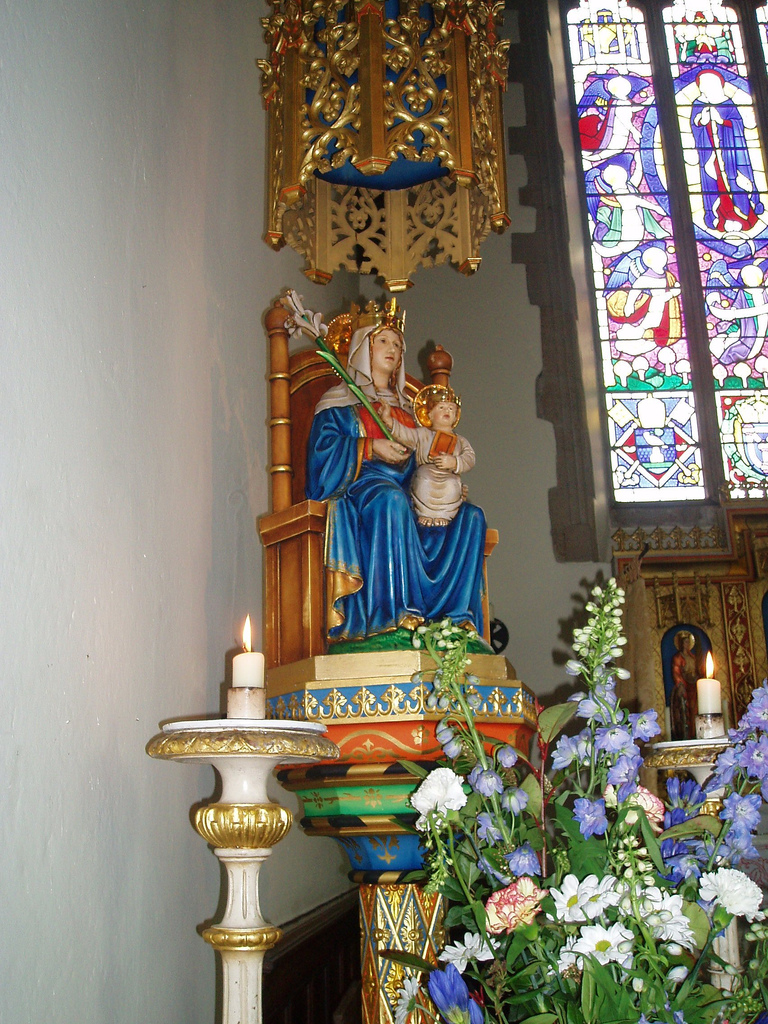
'Holy Mary, our most Blessed Queen and Mother'


                                        'Our Lady of Walsingham'


Song to Our Lady

Medieval:  Author Unknown

Of one who is so fair and bright

Velut Maris Stella

Brighter than the day is light,

Parens et puella.

I cry to thee to turn to me:

Lady, pray thy Son for me,

Tam pia.

That I may come to thee,

Maria. 


In sorrow, counsel, thou art best,

Felix fecundate:

For all the weary thou art rest,

Mater honorata:

Beseech Him in thy mildest mood,

Who for us did shed His Blood

In Cruce,

That we may come to Him

In luce.


All this world was forlorn,

Eva peccatrice,

Till Our Saviour Lord was born

De te genetrice;

With thy Ave sin went away,

Dark night went and in came day

Salutis.

The well of healing sprang from thee,

Virtutis.


Lady, flower of everything,

Rosa sine spina,

Thou borest Jesus, Heaven’s King,

Gratia Divina.

Of all I say thou borest the prize,

Lady, Queen of Paradise

Electa:

Maiden mild, Mother

Es effecta.


 Well He knows He is thy Son,

Ventre quem portasti:

He will not refuse thy bone,

Parvum quem lactasti:

So courteous and so good He is,

He has brought us to our bliss

Superni.

Who hast shut up the dark foul pit

Inferni.


Bone, request.

The alternate Latin lines mean:

            As the star of the sea

            Mother and maid

            So loving

            Mary

            Happy and with offspring

            Honourable Mother

On the Cross

In light

From Eve a sinner

Of thee mother

Of salvation

Of virtue

Rose without a thorn

Grace Divine

Elect

Thou art become

Whom thou didst bear in the womb

Whom thou didst suckle as a baby

Of heaven

Of hell.

                                 Medieval: author unknown.         

                                    (ack.’The Mary Book’ – Sheed and Ward 1950)


                                             *******************


‘The May Magnificat’             by   Gerard Manley Hopkins


May is Mary’s month, and I

Muse at that and wonder why;

            Her feasts follow reason

            Dated due to season--------


Candlemas, Lady Day;

But the Lady Month, May,

            Why fasten that upon her,

            With a feasting in her honour?


Is it only its being brighter

Than the most are must delight her?

            Is it opportunest

            And flowers finds soonest?


Ask of her, the mighty mother:

Her reply puts this other

            Question:  What is Spring?

            Growth in every thing --------


Flesh and fleece, fur and feather,

Grass and greenworld all together;

            Star-eyed strawberry- breasted

            Throstle above her nested.


Cluster of bugle blue eggs thin

Forms and warms the life within:

            And bird and blossom swell

            In sod or sheath or shell.


All things rising, all things sizing

Mary sees, sympathising

            With that world of good,

            Nature’s motherhood.


Their magnifying of each its kind

With delight calls to mind

            How she did in her stored

            Magnify the Lord.


Well but there was more than this:

Spring’s universal bliss

            Much, had much to say

            To offering Mary May.


When drop-of-blood-and-foam-dapple

Bloom lights the orchard-apple

            And thicket and thorp are merry

            With silver-surfed cherry.


And azuring-over greybell makes

Wood banks and brakes wash wet like lakes

            And magic cuckoocall

            Caps, clears, and clinches all -----


This ecstasy all through mothering earth

Tells Mary her mirth till Christ’s  birth.

            To remember and exultation

            In God who was her salvation.

                                                                       Gerard Manley Hopkins

                                                         (ack. ‘The Mary Book’ Sheed and Ward  1950)


                                        *********************


File:Our lady of Walsingham I.jpg

'Our Lady of Walsingham'   (ack. Saracen 78 at Wikipedia)

                                           ***********

“But He, taking her by the hand, cried out, saying:  Maid, arise.

And her spirit returned,  and she arose immediately.  And He bid them  to give her to eat”  (Luke viii.  54/5)


A friend of Our Lord’s in Galilee

Had a dear little girl who died.

Her mother was sad, and her father was sad,

And everybody cried.


Our Lord was coming to make her well,

But she died before He came,

So they told Him not to bother,

But He bothered all the same.


He took the little girl’s hand in His,

And said:  “Little maid, arise!”

And the little girl came to life again,

Sat up, and opened her eyes!


Death must come to stay at last

And sorrow hard to bear,

But it doesn’t really matter,

So long as Our Lord is there.


            So we ask Our Lady

            To pray for us then

And come to us and bring her Son

“At the hour of our death.

                                                Amen.”


    Taken from ‘The Hail Mary’  by  Margaret Hunt.

                 (Ack. The Mary Book  Sheed and Ward 1950.

Tuesday, 17 March 2020

'The Rosary' by Caryll Houselander - a prayer of love.


Many years ago I posted a copy of this beautiful poem on this blogsite. I have been wracking my brain to find a suitable subject as a post which is  sufficiently positive and affirmative to overcome the negativity and godlessness of our current 'coronavirus' media saturation. I have been drawn yet again to this lovely poem, overflowing with love of God, of humanity and God's Creation, instilling  peace and divine hope in our hearts. 


Frances Caryll Houselander
- mystic, poet, artist, writer
         (1901 - 1954)


The Rosary

In the doorway of a low grey house,
built of stones as old as the Crusades,
a woman of Bruges sits in the sunlight,
among the flowers, saying her Rosary.

She seems to be carved out of season walnut

and polished smooth
by the constant touch of the hand of God,
and the beads that twine her crippled fingers
are scarlet berries on the thorny twigs.

The running rhythm
and the repetition
of the Paters and the Aves
is like the rhythm that in nature
moves through the seasons
from seed to harvest
with the unity
and the pause and stress
of music;
like the bloodstream of Christ,
that flows through the seasons
from Advent to Easter
in the Liturgy of the Church,
the ebb and flow of the tide of love
in the Mystical Body of Christ.
             
II
God has given His children strings of beads,
as we give strings of beads to our children,
to teach them to count.

We do not say,
“Learn from these the doctrine of numbers,
the measure of human life,
the dream of Pythagorus,
counting the pulse of the world.”

We do not say
to a child with a string of beads,
“learn the perfection of reason in mathematics.”

We say,
“Learn to count on the beads,
small for your hands to hold,
bright for your eyes to see.”
And he begins,
slowly,
with one, two, three:
the spark is kindled
to light the flame of philosophy.

God has counted in fifteen Mysteries,
on the fingers of human creatures,
the singleness of the Undivided Love,
the simplicity
that we cannot comprehend
because our hearts are divided.
       
III
We are not all vessels of gold,
lifted up in virginal hands,
empty chalices to receive
from the perfect vine
love,
absolute
and complete.

But the old woman of Bruges
is a round bowl,
lifted up to be brimmed
with pure wine.
and the Mysteries of the Rosary
concern familiar things
known in her own life.

Her mind, like a velvet bee
droning over a rose,
gathers the honey of comfort
from the story of God,
familiar as the things in her kitchen –
the shining pots and pans,
the milk in the jar of earthenware,
and the flags of the scrubbed floor.

The story told by the Rosary
is the story of primitive beauty,
true as the burden of folk- songs.
It is a song piped on the hills,
by a shepherd calling his sheep.
     
IV
The cradle of wood,
the wood of the cross;
from cradle to cross,
like a lullaby;
the wail of an infant,
lost on the wind –
the arms of a girl
in a circle of love,
rocking to rest;
a woman’s arms
in a circle of love,
the young Man dead
on His Mother’s breast.

The jewels that glow
low in the grass
on the feet of Christ,
risen from death,
touching the flowers
and touching the dust,
even in glory.

The dust of the earth
on the feet of God,
walking the soft blue meadows of stars.
     
V
In the doorway of a low grey house,
built of stones as old as the Crusades,
a woman of Bruges
sits in the sunlight, among the flowers,
saying her Rosary.

The story of Mary is her own story,
and her son was her life’s joy
and her life’s sorrow;
and for ever
her son is her life’s glory.

In a field in Flanders,
among the red poppies, he is sleeping:
he will sleep soundly
until the day of resurrection.

She has still the patchwork quilt
made, when her hands were nimble,
for the wooden cot:
now he is sleeping, and each year
he has a new coverlet
of delicate young grass,
and at the end of his cot
a wooden cross.

The cradle of the wood,
the wood of the cross:
from cradle to cross,
like a lullaby.

The story of the woman of Bruges
is the world’s story.
it is the story
of human joy and sorrow,
woven and interlaced,
like the blue and crimson thread
in a woven cloth:
the story of birth and death,
of war and the rumours of war
and of peace past understanding,
peace in the souls that live
in the life of Christ.

In the doorway in Bruges,
sitting among the flowers,
her mind like a velvet bee
droning over a rose,
taking the honey of comfort
out of the heart of Love,
the old woman is nodding
over her Rosary.

She has lived her meditation,
like the Mother of God,
living the life of Christ:
let her sleep in Christ’s peace.
       
VI
Under the loud din
of the tramp of metallic feet
in the armed march of time,
like a river moving
under the dark hills,
the everlasting life
is flowing, eternally.

The measured beat of love,
with pure perfection of music,
timing the life of Christ
in the human heart
goes on.
                   Frances Caryll Houselander

                             
                             *********************
   
 'Frances Caryll Houselander was born in Bath, England, on Sept 29, 1901, the second of two daughters.  She was not expected to survive for more than a day, and was immediately baptized,  given the name ‘Frances’ after her uncle, a gynaecologist who helped deliver her, and ‘Caryll’,  after the yacht on which her mother had spent the last months of her pregnancy!
     She went on to survive her first day, and indeed many more after that, though her health continued to be poor throughout her life.
     When she was 6 years old, a family friend persuaded her mother to have the children baptised in the Catholic faith. Although little formal religious education followed her reception into the Church, her mother encouraged a deep sense of piety and devotion in the home, and Frances, a devout child,  made her first confession and Holy Communion when she was just seven years old.
     Two years later, her world was shattered when her parents  separated. Though they were never  divorced, the separation was to be a permanent one. For the next several years, she changed homes and schools, never fully settling in one place before she was moved to the next.
     Her erratic health led her doctors to advise that she avoid all class work, and,  by the time she returned home in 1917, her formal education was virtually non-existent.  During her years in the convent schools, she experienced three religious visions, which led to a personal and absolute conviction that she had been called by Christ to give recognition to the reality of His loving Presence and Image in all people, particularly the suffering and poor of this world, and to convey the realisation and awareness of this to all those with whom she came into contact, personally and through her writings. Frances had a great affinity with young children, and during her life wrote and illustrated children's books, always revealing a simple delight in the love of God and His creation.
     When the war ended, she attended art school and it was during this period that she drifted from the Catholic Church. She explored the Orthodox Church among others, but found them all wanting, and craving for peace of soul and longing for the Sacraments, she returned to the Catholic Church; she was then twenty-four years old.
     Advised to concentrate on her writing, she  began to write articles and illustrate for the ‘Children’s Messenger of the Sacred Heart’, often on an unpaid basis. Her work ultimately led to her making the acquaintance of the Catholic publishers, Sheed and Ward, who were subsequently to  become the major publishers of her many books.
     Always willing to open her home and her heart to those in need, she was frequently physically and emotionally  overwhelmed by those who sought her advice, yet she remained reluctant to turn people away.
     Msgr. Ronald Knox, a contemporary, and admirer of Houselander, recognized her tremendous gift of insight, and was later to say, "She seemed  to see everything for the first time, and the driest of doctrinal considerations shone out like a restored picture when she had finished with it." 
     Her popularity and success in healing the hurts and the hearts of many can be measured by the support of such eminent physicians as Dr. Strauss, later President of the British Psychological Society, who sent patients to her. His explanation was that "she loved them back to life".
     Her impact, both literary and personal, was due above all, to the intensity of her vision of the suffering Christ, a vision she expressed with utter sincerity and immediacy and, on occasion, with breathtaking luminosity. Indeed, she can best be described not just as a writer, nor even just an artist, but as a mystic and a visionary, even in the tradition of Julian of Norwich, Catherine of Siena, or Teresa of Avila, which would explain how she was able to communicate so directly and movingly to her large reading public, and accounts for her extraordinary success in counselling British and foreign children who had been traumatized by the war.
     Not gregarious by nature, she nevertheless radiated gaiety and a  sense of fun; her wickedly funny tongue often provoking as much hilarity among her intimates as it caused her remorse. 
     She was unquestionably a genuine mystic whose frailties were transformed into real strength and whose neuroses became the means whereby she was able to join her sufferings with Christ on the cross.It was as though her burning love of God overflowed for the refreshment of all who came in contact with her.
    "She seemed to possess a well that never ran dry for anyone but herself. She gave of her food to feed the hungry, her time to counsel those in need, her energy to write countless letters, articles and books, and ultimately her health for the health and well-being of others. She spent years attending to the rigorous demands of her ailing parents, and, having been plagued by ill health her entire life, had become accustomed to pain and slow to address her own physical ailments. Her lack of self-concern, however, which extended to everything from her looks, to her diet, her sleep, her health, her living quarters, etc., took its toll."
      During her last years, she worked tirelessly to complete books, write letters, strengthen the works of charity she had begun, and minister to the many mentally ill children who were sent her way'            
      She died on October 12, 1954, from breast cancer. 
"The wonder of Frances Caryll Houselander is found in her humble willingness to suffer with Christ, to let Him transform her flawed and sinful nature into a divine work of art."


Ack.  Karen Lynn Krugh / Catholic Culture.org
Ack.  Margot H. King - currently working on biography for Peregrina Publishers.
Ack.   Robin Maas - Caryll Houselander, an appreciation.
www.ewtn.com/library


                      *******************************
Books by Caryll Houselander

SPIRITUALITY
"Guilt"
"The Reed of God"
"This War is the Passion"
"The Stations of the Cross"
"The Passion of the Infant Christ"

AUTOBIOGRAPHY
"A Rockinghorse Catholic"

ANTHOLOGIES
"The Mother of God"
"A Rockinghorse Catholic"

BIOGRAPHY
"Caryll Houselander: That Divine Eccentric" by Masie Ward


'The Last Four Sorrows' of Our Lady' - Charles Journet

  'The Last Four Sorrows of Our Lady' Charles Journet                          Fourth Sorrow   This was Mary’s sufferings ...