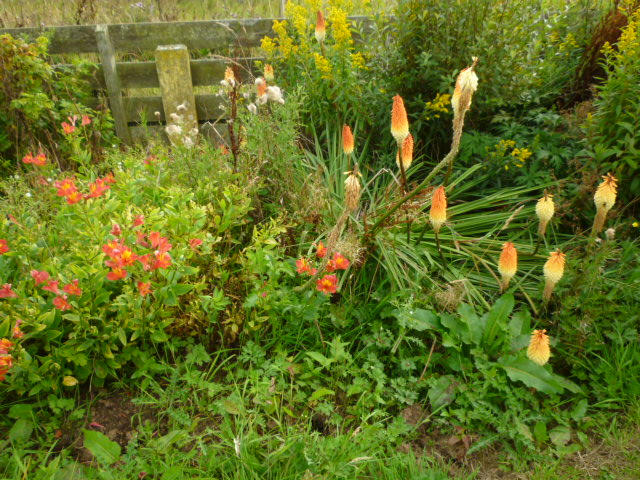
Tuesday, 14 March 2023

Happy memories of our garden last summer.


It is now March, the garden has been wind-swept and to all appearances barren for several months, but at last we can enjoy the golden and purple crocus peeping up above the lawn,  and the early daffodils rising to the challenge. Before either of these, we admired a lovely show of snowdrops scattered around the garden, increasing every year, and safe from the scavenging of hungry mice, who particularly enjoy crocus and tulip bulbs, much to my wife's understandable annoyance.

I apologise for neglecting my blog-site over the past three months, I just seem to have been caught up in other matters, on the internet in particular, which have taken up a great deal of my time.

I hope that you enjoy these few photographs of our garden last summer, I had saved them on my computer for posting on my blog, and here they are - a reminder of summer past and summers to come! They are nothing special, no rare or unique varieties of plants, but they reflect the beauty of flowers in the summer-time, just a tiny taste of the beauty of God's creation. 


 Nothing particularly exciting or special about these photographs, but I am reminded of the delight and satisfaction the flowers brought  to my wife, the planner and  main artisan in the garden, and to me, primarily responsible for keeping the grass under some sort of control! This winter seems to have been  interminably long, very windy, very cold, and very wet, with a few light falls of snow. Things were not helped  by innumerable power cuts, some lasting several hours, which do make life difficult. I suddenly remembered that I had these photographs stored on my computer, and looking at them cheered me up to such an extent, that I persuaded myself to post them on this blog and perhaps bring some pleasure to  others, who like me, may be suffering from  debilitating  'long winter syndrome' (LWS). The photos are quite ordinary, but the flowers are a promise of things to come!

There is no denying that the World is in a mess, primarily due to the abandonment of God's commandments by so many nations and so many people. Corruption in all walks of life, gross immorality and evil, brazenly and publicly promoted, confirm the supernatural and natural threat of the devil and his minions; together with the very real threat of the 'Great Reset' and the agenda for 'One World Government', which seeks the complete control of mankind and the negation of Almighty God and His laws.

The devil and his followers might win a battle but they will not win the war, of this we can be absolutely sure. This world  is God's creation, as is humanity created by God in His own image. Satan will be crushed, as he was by Christ in the desert, but  I believe that we must all play our part  and do  everything possible to sabotage this attempted evil  take-over of humanity by the globalist elites. Faith and courage, prayer and penance, are our main weapons, relying always on the omnipotence of God and His unending love for humanity, for whose salvation God the Son, Jesus Christ, became man and was crucified for our sins,  that we might have eternal life. 

Wishing you all fruitful and happy gardening!

Saturday, 19 November 2022

'The Crosses on the Wall - a legend of Primiero' by Francesca Alexander (1837 - 1917)


   I have only recently become acquainted with the book 'The Hidden Servants and other very old stories - told over again by Francesca Alexander', and published by David Nutt, at the Sign of the Phoenix, Long Acre, London, in 1911, in which is a collection of  Italian  legends sourced over many centuries, and re-presented in poetic form by Francesca Alexander, author and artist, born in the U.S.A., who at the age of 16 years moved with her father, a portrait painter, and her mother, a wealthy philanthropist, to Italy, settling in Florence for the rest of her life. 

    In the Preface to this book, Anna Fuller quotes from a letter she received from Francesca Alexander, regarding the sources of the legends, written with no thought of publication, but as it were, from the heart. This is what Francesca wrote: - 

        "With regard to this present collection of ballads, I can tell its history in a few words. When I was a young girl many old and curious books fell into my hands and became my favourite reading (next to the Bible, and, perhaps, the Divina Commedia), as I found in them the strong faith and simple modes of thought which were what I liked and wanted.  Afterwards, in my constant intercourse with the country people, and especially with old people whom I always loved, I heard a great many legends and traditions, often beautiful, often instructive, and which, as far as I knew, had never been written down. I was always in request with children for the stories which I knew, and could tell, and, as I found they liked these legends, I thought it a pity they should be lost after I should have passed away, and so I always meant to write them down; all the more that I had felt the need of such reading when I was a child myself. But I never had time to write them as long as my eyes permitted me to work at my drawing, and afterwards, when I wanted to begin them, I found myself unable to write at all for more than a few minutes at once.  Finally, I thought of turning the stories into rhyme and learning them all by heart, so that I could write them down little by little.  I thought children would not be very particular, if I could just make the dear old stories vivid and comprehensible, which I tried to do.  If, as you kindly hope, they may be good for older people as well, then it must be when the Lord took from me one faculty, He gave me another, which is in no way impossible.  And I think of the beautiful Italian proverb: 'When God shuts a door, He opens a window.'" 

        After such an account of the origin and growth of these poems no further comment would seem fitting, unless it be that made by Cardinal Manning when writing to Mr  Ruskin in 1883 to thank him for a copy of Francesca's 'Story of Ida'.  He writes: -- "It is simply beautiful, like the Fioretti di San Francesco. Such flowers can grow in one soil alone.  They can be found only in the Garden of Faith, over which the world of light hangs visibly, and is more intensely seen by the poor and the pure in heart than by the rich, or the learned, or the men of culture."

                                                                     ANNA FULLER.

                                                **************

'This beautiful legend Has for me a most peculiar interest, owing to the circumstances under which I first heard it. It was taught to me by a very dear young friend whom I had known and loved from his infancy, -- Piero, the only surviving child of Count Giuseppe Zanelli of Faenza.  It was only last October -- eight months ago -- and we were all staying together in the home of his beloved and still beautiful grandmother, at Bassano, in the Veneto.  It was the last evening that we expected to pass together, and Pierino (we had never been able to give up calling him by that childish diminutive) brought a book with him, a collection of popular legends compiled by De Gubernatis, and said that he had a story to read us.  It was "The Crosses on the Wall", and it has always seemed to me as though he read it on that particular evening to prepare us for what was to come. For some months he had been not quite so strong as usual, yet no one felt any particular apprehension, until on the twenty-eighth of November he died, almost without warning. He was twenty-two years old, of a very beautiful character, -- so good that we ought to have known he was not for us. With him two great and ancient families come to an end, --- the Pasolini-Zanelli of Faenza, and the Baroni-Semitecolo  of Bassano: these last are the only descendants of that Semitecolo who worked in mosaic at Torcello.'

                                                                        Francesco Alexander

                                                          ************

The Crosses on the Wall

A Legend of Primiero


Come, children, listen to what I tell,

For my words are wise today:

From Primiero among the hills

Was the legend brought away.


And Primiero among the hills

Is a little world apart,

Where is much to love and much to learn,

If you have a willing heart.


It lies on high, like a stranded ship,

From the parted wave of time;

Not far from the troubled world we know,

But the way is hard to climb.


For the mountains rise and close it in,

With their walls of green and gray;

With crag and forest and smooth-worn cliff,

Where the clouds alone can stray.


And when a house they have builded there,

If a blessing they would win,

Above the door do they write a prayer,

That Christ may dwell therein.


And I think, throughout the ancient town,

On its steep ascending road,

In many a heart, in many a home,

Has He taken His abode.


And when a burden is hard to bear –

And such burdens come to all –

They tell the story I’m telling now,

Of the crosses on the wall.


‘T is a pearl of wisdom, gathered far

In the dim and distant past;

But ever needed, but ever new,

As long as the world shall last.


For never has been since earth was made,

And surely shall never be,

A man so happy or wise or great,

He might from the cross be free.


The tale it is of a widow poor,

And by trouble sorely pressed;

Of how, through sorrow and many tears,

At the end her soul was blest.


She had not been always poor and sad,

For her early years were bright,

With a happy home, and with parents kind,

And herself their hearts’ delight!


A mother’s darling, a father’s pride,

She was fair in form and face;

A sunny creature, a joy to all,

For her sweet and winning grace.


Then, early married to one she loved,

She had still been shielded well;

For her he laboured, for her he thought,

And on her no burden fell.


She worked, indeed; but what work was hers

Through the short and happy hours?

To pluck the fruit from her orchard trees,

Or to tend the garden flowers;


To sit and spin, and to sing the while

In her porch with roses gay;

To spread the table with plenty piled,

And to watch the children play.


Their home was a little nest of peace;

‘T was a mile beyond the town,

In that sheltered valley, green with woods,

Where the river murmurs down.


And she never dreamt of change to come,

(Though a change must all expect,)

Till the blow, like lightning, on her fell,

And her happy life was wrecked.


But who could have thought the man would die?

There were few so strong as he!

From his forest work they bore him home,

Struck dead by a falling tree.


A petted child, and a wife beloved,

She had hardly sorrow known,

Till the strong, brave man was borne away,

And she faced the world alone.


Alone, with a babe too young to speak,

And with other children five:

“Oh, why,” she asked, “are the strong removed

And the feeble left alive?”


But where is the good of asking why,

When our helpers disappear?

That question never was answered yet,

And it never will be, here.


There was little time to sit and weep;

She must rise, and bear the strain;

Alone she stood, with the home to keep,

And the children’s bread to gain.


The best of herself had gone with him;

She had no more faith nor trust:

She could not bow to the Lord’s decree,

For she felt it all unjust.


The good Lord cares for a widow’s need,

But on Him she did not call.

She laboured hard, and she fought with fate,

And they lived – but that was all.


She fought her battle with fate, and failed,

As many have failed before;

If against the thorns we push and press,

They will only prick the more.


She could not bear with the children now,

And she called them rude and wild;

Forgetting quite, in her sullen grief,

That she had been once a child.


Yes, wild they were; and like all wild things

They were light and swift and strong;

And her poor, sick spirit turned away

From the gay, unruly throng.


They swam the river, they climbed the trees,

They were full of life and play;

But oft, when their mother’s voice they heard,

They hid from her sight away.


They did not love her, and that she knew,

And of that she oft complained;

But not by threats nor by angry words

Could the children’s love be gained.


Respect and honour we may command;

They will come at duties call:

But love, the beautiful thornless rose,

Grows wild, when it grows at all.


And she grew bitter, as time went on,

Grew bitter and hard and sore,

Till one day she cried in her despair,

“I can bear my life no more!


“Look down from Heaven, good Lord, and see

And pity my cruel fate!

Oh, come, and in mercy take away

My burden, for ‘t is too great!


“My heart is breaking with all its load,

And I feel my life decline;

Never I think did the woman live

Who has borne a cross like mine!”


To her cry for help an answer came,

And solemn it was, and strange!

For a silence deep around her fell,

And the place seemed all to change.


She stood in a sad and sombre room, 

Where from ceiling down to floor,

Along the wall and on every side,

There were crosses – nothing more.


There were crosses old, and crosses new,

There were crosses large and small;

And in their midst there was One who stood

As the Master of them all.


Before His presence her eyes dropped low,

And her wild complaining died;

For she knew the cross that He had borne

Was greater than all beside.


And He bade her choose, and take away,

From among the many there,

Another cross, in exchange for hers,

That she found too great to bear.


She looked for those that were least in size,

And she quickly lifted one;

But oh, ‘t was heavy, and pained her more

Than her own had ever done!


She laid it back with a trembling hand –

“And whose cross is that?” she cried;

“For heavier ‘t is than even mine!”

And a solemn voice replied:


“That cross belongs to a maiden young,

But of youth she little knows;

For the days to her are days of pain,

And the night brings scant repose.


“A helpless, suffering, useless thing!

And her pain will never cease,

Till death in pity will come one day,

And her troubles end in peace.


“She never has walked the pleasant fields,

Nor has sat beneath the trees;

The hospital wall that shuts her in

Is the only world she sees.


“She has no mother, she has no home,

And in strangers’ hands she lies;

With none to care for her while she lives,

Nor weep for her when she dies.”


“But why is the cross so small, my Lord,

And why does her heart not break?”

“She counts it little,” the answer came,

“For she bears it for my sake.”


The widow blushed with a sudden shame;

To her eyes the tears arose:

She dried them soon, and again she turned,

And another cross she chose.


It fell from her hand against the wall,

And she let it there remain:

“That cross shall never be mine,” she said,

“Though I take my own again!


“And whose is this that I cannot hold?

For it seems to burn my hand!

And never, I think, was heart so strong

That could such a weight withstand.”


“The cross it is of a gentle wife,

And she wears it all unseen;

With early sorrow her hair is white,

But she keeps a smile serene.


“She gave her heart to an evil man,

And she thought him good and true;

And long she trusted and long believed,

But at last the truth she knew.


“She knows that his soul is stained with crime,

But the worst she still conceals;

Abuse and terror her sole reward,

And the lord knows what she feels!


“She cannot leave him, for love dies hard,

And her children bear his name;

But she prays for grace, to keep and guard

Their innocent lives from shame.


“She trembles oft when his step she hears

On a lonely winter night;

And she hides her frightened babes afar

From their cruel father’s sight.


“And she dares not even hope for death,

Though his hand might set her free:

‘T were well for her in the grave to rest;

But where would the children be?”


The widow shuddered, her face grew pale,

And she no more turned to look:

She reached her hand to the wall near by,

And a cross by chance she took.


‘T was not so large as the first had been,

But it seemed a fearful weight!

“And whose am I holding now?” she asked,

For it did not look so great.


“A mother’s cross is the one you bear,”

So the voice in answer said,

“And she once had children six like you;

But her children all are dead.


“She has all besides that earth can give;

She has friends and wealth to spare,

And house and land – but she counts them not,

For the children are not there.


“Time passes slowly, and she grows old;

But she may not yet depart.

In lonely splendour she counts the years,

With an empty, hungry heart.


“And she knows by whom the cross was sent,

And she tries her head to bow;

But six green mounds by the churchyard wall

Are the most she cares for now.”


The widow thought of her own wild brood,

And she felt a creeping chill:

And, “Oh give me back my cross!” she said,

“I will keep and bear it still.


“Forgive me, Lord” (and with that she knelt,

And for very shame she wept).

“I know my sin, that I could not bow,

Nor Thy holy will accept.


“Oh, give me patience, for life is hard;

And the daily strength I need!

And by Thy grace I will try to bear

The burden for me decreed.


“I’ll change my ways with the children now,

Though they give me added cares.

Poor babes! I know, if they love me not,

That the blame is mine, not theirs!”


She kept her word as the weeks went on,

And she fought with fate no more:

‘T was now with a patient, humble heart

That her daily cross she bore.


The children wondered to see her change

So greatly in look and speech!

She met them now with a smile so kind,

And a gentle word for each.


And soon they learned, from her altered ways,

What her words had vainly taught;

Their love, that long she had claimed in vain,

Came back to her all unsought.


There were merry shouts and dancing feet,

When the mother came in sight;

There were little arms around her thrown,

There were eyes with joy alight.


With love for teacher, they learnt to help,

There was work for fingers small:

Her heart grew soft like the earth in spring,

And she thanked the Lord for all!


Her girls so pretty, her boys so brave,

And so helpful all and kind!

She wondered often, and thought with shame

Of how she had once repined.


For in their presence she oft forgot

Her burden of want and care,

Forgot her trouble – forgot, almost,

That she had a cross to bear!


************ 


'The Holy Family' by Paolo Veronese (1528 - 1588)


NB. For a further work by Francesca Alexander, please see 'Whitesmokeahoy' blog  dated 18 November 2022, 'The Bag of Sand' 


whitesmokeahoy: 'The Bag of Sand' by St. Heradius 


Sunday, 30 October 2022

The 'Godfather' of Climate Change


                           Maurice Strong (1929 - 2015)

(The following article is taken from the Expose 23 October, 2022 - with thanks.)

The Man who invented Climate Change and influenced Schwab’s Great Reset Agenda

According to such Great Reset luminaries as Bill Gates, Prince Charles, Michael Bloomberg, Mark Carney and Klaus Schwab, humanity is expected to solve the dual threat of Covid and global warming in one revolutionary sweeping reform.

We plebeians have been told that all we have to do to restart the economy is rewire everything about our behaviour, value, finance, and ethics to decarbonise civilization under a new world regime of central bankers and new green digital currencies as outlined by the Green Horizon Summit held on 9-10 November 2020.

The Summit was hosted by the City of London Corporation, in collaboration with the Green Finance Institute, and supported by the World Economic Forum (“WEF”): “It’s time to reset the relationship between finance and the real economy. It’s time for public and private finance to get behind the transition to a sustainable and resilient future for all.”

It was at this event that keynote speaker Mark Carney announced that the total net zero transition represents “the greatest commercial opportunity of our time”:

“Climate change, the crisis that involves the entire world and from which no one will be able to self-isolate … 126 governments have now committed to net zero including three global giants – China, Japan and South Korea, in the last few weeks … Given the wholesale shift in economic and social drivers of values since Covid …  Businesses of all stripes increasingly recognise the changing consumer preferences and new climate policies are creating the greatest commercial opportunity of our time … Our objective for COP26 is to build the framework so that every financial decision can take climate change into account.”

link:-    The Cartography of Post-COVID-19 Green Growth, Mark Carney, 9 November 2020 (19 mins, begin timestamp 08:45)

There is a destructive plan to transform the global financial system under the guise of “climate change” and we should be concerned about the “green” financial swindle that is underway. It is not just a financial swindle but one of the largest natural land resource grabs in the history of our planet, read more HERE.

In a 2019 article, Paul Gallagher described Carney as the most influential central banker in the world. He has held the most senior positions in global central banking in the shortest period of time and is probably more responsible than any other figure – except possibly his billionaire partner Michael Bloomberg – for the current rampage of environmentalist assaults on modern industrial society.

Canadian eco-fascist Mark Carney, formerly Governor Bank of England, is on WEF’s Board of Trustees and is UN Special Envoy for Climate Action and Finance.  He seems to have a lot in common with the Canadian eco-fascist Maurice Strong – “inventor of climate change” – who was a co-founder of WEF and the architect of Agenda 21, which led to its ugly sister Agenda 2030.

Maurice Strong the Godfather of “climate change”

On his death in 2015 The Telegraph hailed Maurice Strong as the man who invented climate change, “to this day, global climate policy is still shaped by the agenda of Maurice Strong, a Canadian multimillionaire.”  But to those who have looked behind the veil of corporate media propaganda, he’s known as the Godfather of climate change – Godfather , as in crime boss.

Amongst others, Strong was Secretary General of the first United Nations Conference on the Environment and Population in 1972, President of the Rockefeller Foundation, head of the World Bank, head of the United Nations Environmental Program, a member of the Foundation Board of the World Economic Forum and a committed socialist and globalist.

He was also one of Klaus Schwab’s mentors.  Schwab’s other mentor was Henry Kissinger. Kissinger recruited Schwab through the “International seminar,” a CIA-funded program at Harvard University, and introduced him to Ken Galbraith. Galbraith was a Canadian-American economist, diplomat, public policy maker, and Harvard intellectual.  Kissinger and Galbraith were the real driving force and helped Schwab create the World Economic Forum.

On Strong’s death in 2015, Schwab delivered the following remarks:

“[Strong] was my mentor since the creation of the Forum: a great friend; an indispensable advisor; and, for many years, a member of our Foundation Board. Without him, the Forum would not have achieved its present significance.”

The video clip below, taken from CBC’s 2004 documentary ‘Life and Times’, highlights the dizzying speed with which Strong rose to power, as well as his many “elite” associations. In the YouTube description section, Matthew D. Jarvie wrote:

“Despite having little education and almost no credentials, Strong was quickly risen through the ranks of power after being vetted by globalist kingpin David Rockefeller in the mid-40s, at the United Nations headquarters in New York City, after Strong landed a job there with the help of people who had connections to the UN.

“This clip takes a look at one of the world’s leading figures behind the New World Order agenda, and someone near the very top of the global warming/global tax/one world government swindle … While the documentary casts an unabashedly favourable and glowing light on Strong, those who have done the research and have studied Strong’s background and associations understand that this simply isn’t the case.”

In 1947, Maurice Strong took his first job as a clerk at the United Nations in New York. There, he befriended David Rockefeller, who helped to advance Strong and provided him with a network of influential contacts.  In 1966, Strong became head of the Canadian International Development Agency (“CIDA”).

In 1971, while still heading up the Canadian International Development Agency, Maurice Strong became a founding member of the 1001 Nature Trust, which was an elite international organisation created by Prince Bernhard of the Netherlands and Prince Philip Mountbatten. The 1001 Trust worked in tandem with Prince Bernhard’s other secretive club known as the “Bilderberg Group” which he founded in 1954 and was designed to fund the emerging new ecology movement. All 1001 members paid $10 000 for their membership which was pooled to fund the World Wildlife Fund and other green organisations.

Strong was the most active and influential member of the Brundtland Commission, a panel which the UN General Assembly established in 1983 to promote “sustainable development.” He helped produce the Commission’s 1987 report, ‘Our Common Future’, which, as a result of Strong’s influence, placed a heavy emphasis on the dangers of anthropogenic climate change – climate change caused by humans – and the virtues of socialist redistributionism. In the words of a report in the American Thinker, the Brundtland report:

  • was a call for social and economic egalitarianism within a simple Marxist dialectical framework;
  • [claimed that] the antagonism between capitalist and proletarian worker mirrored the antagonism between industrialised and developing nations;
  • identified [the First World] as the primary culprit behind Third-World underdevelopment [and] environmental degradation;
  • [argued that] more money to the developing world from rich Western nations [was] the solution; and
  • would become so influential that Western governments would try reversing the effects of the Industrial Revolution in their own countries through restrictions on CO2 emissions and increasing dependence on unreliable biofuels and green technologies.

In 1988, Strong convinced the United Nations Environment Program (“UNEP”) and the World Meteorological Organisation (“WMO”) to agree to the formation of an “intergovernmental mechanism” to monitor anthropogenic global warming and suggest policy recommendations for the UN and Western governments.  This organisation was the Intergovernmental Panel on Climate Change (“IPCC”).

Through the IPCC and other UN bodies, enormous sums of money were transferred from the West to third-world countries.  In 2010, the Green Climate Fund (“GCF”) was established. Its purpose was to further the UN goal of socialist redistribution in the name of sustainable development.

In 1990 a Canadian reporter, Daniel Wood, interviewed Strong.  Strong’s remarks included:

“Isn’t the only hope for the planet that the industrialised civilizations collapse? Isn’t it our responsibility to bring that about?”

Fox News’ Glenn Beck highlighted this comment in 2010 during Part 1 of a series titled ‘Exposing Crime Inc.’


As summarised by the Geller Report, Strong then took to his website to address the issue and wrote:

“A particularly dishonest statement … citing a fictional account which was clearly stated to be an extreme scenario of what might happen by the year 2030 if we failed to act.”

In an interview, the Guardian asked Strong about Glenn Beck dedicating a show to attack him.  Strong responded:

“You know what? I haven’t actually seen that show. But we wouldn’t be having this conversation if he hadn’t attacked me. I’m never going to be immune from criticism.”

In 1993, Strong was one of the key organisers and the Chairman of the UN’s 1992 Earth Summit held in Rio de Janeiro.  One of the major outcomes of the Summit was the Agenda 21 document, of which Strong was one of the authors.

From its inception in 1992 at the United Nation’s Earth Summit, 50,000 delegates, heads of state, diplomats and non-governmental organisations (NGOs) hailed Agenda 21 as the “comprehensive blueprint for the reorganisation of human society.” The 350-page, 40-chapter, Agenda 21 document was quite detailed and explicit in its purpose and goals.  They warned us that the reorganisation would be dictated through all-encompassing policies affecting every aspect of our lives, using environmental protection simply as the excuse to pull at our emotions and get us to voluntarily surrender our liberties.

Section I details the “Social and Economic Dimensions” of the plan, including redistribution of wealth to eradicate poverty, maintain health through vaccinations and modern medicine, and population control.

To introduce the plan, the Earth Summit Chairman, Maurice Strong boldly proclaimed, “Current lifestyles and consumption patterns of the affluent middle class – involving meat intake, use of fossil fuels, appliances, air-conditioning, and suburban housing – are not sustainable.” Of course, according to the plan, if it’s not “sustainable” it must be stopped.

link:-     Green New Deal Reveals the Naked Truth of Agenda 21, American Policy Centre, 25 February 2019

American Policy Centre also noted that Agenda 21 was summed up in supporting documents this way:

“Effective execution of Agenda 21 will require a profound reorientation of all human society; unlike anything the world has ever experienced. It requires a major shift in the priorities of both governments and individuals, and an unprecedented redeployment of human and financial resources. This shift will demand that a concern for the environmental consequences of every human action be integrated into individual and collective decision-making at every level.”

As reported in 2019 by The Times of India, the specific issue of climate alarm originated as part of the Club of Rome of 1968 and its 1973 ‘Limits of Growth’ report.

One of the Club of Rome associates was Maurice Strong who played a particularly insidious role in drumming up a range of anti-poor hysterias … He had a revulsion for people. In his 2000 autobiography, he dreamt of the day when two-thirds of the world’s population might be wiped out.

Strong was widely supported by thousands of influential like-minded people, many of whom are extremely powerful today: for instance, William Nordhaus … [who] started a life-long focus on CO2 and has long recommended a carbon tax without ever bothering to check whether CO2 is actually a pollutant.

The Club of Rome and its associate organisations remain active and operate behind the scenes. There is a powerful network of people determined to use climate alarm and anti-GM propaganda as instruments to curb agricultural productivity and choke energy use by the poor. Al Gore is perhaps the most well-known but the group includes innumerable “scientists” who are happy to fudge data. The Climategate emails demonstrate how these “scientists” operate in the shadows to distort facts and mislead the public.

 link:-     Looking behind the scenes of the well-orchestrated climate hysteria, The Times of India. 25 August 2019

Fourteen years ago, Matthew D. Jarvie highlighted the connection between the environmental movement and those who are striving to bring about a new system of control to the world. Jarvie began by naming notable members of the Club of Rome.  The first member he named was – Maurice Strong.

Sources and resources:


       Acknowledgement   'The Expose'   23 October, 2022. - with thanks

'The Last Four Sorrows' of Our Lady' - Charles Journet

  'The Last Four Sorrows of Our Lady' Charles Journet                          Fourth Sorrow   This was Mary’s sufferings ...